
Midi Evening Dresses: Shoes, Hemming, and Proportion Rules That Work
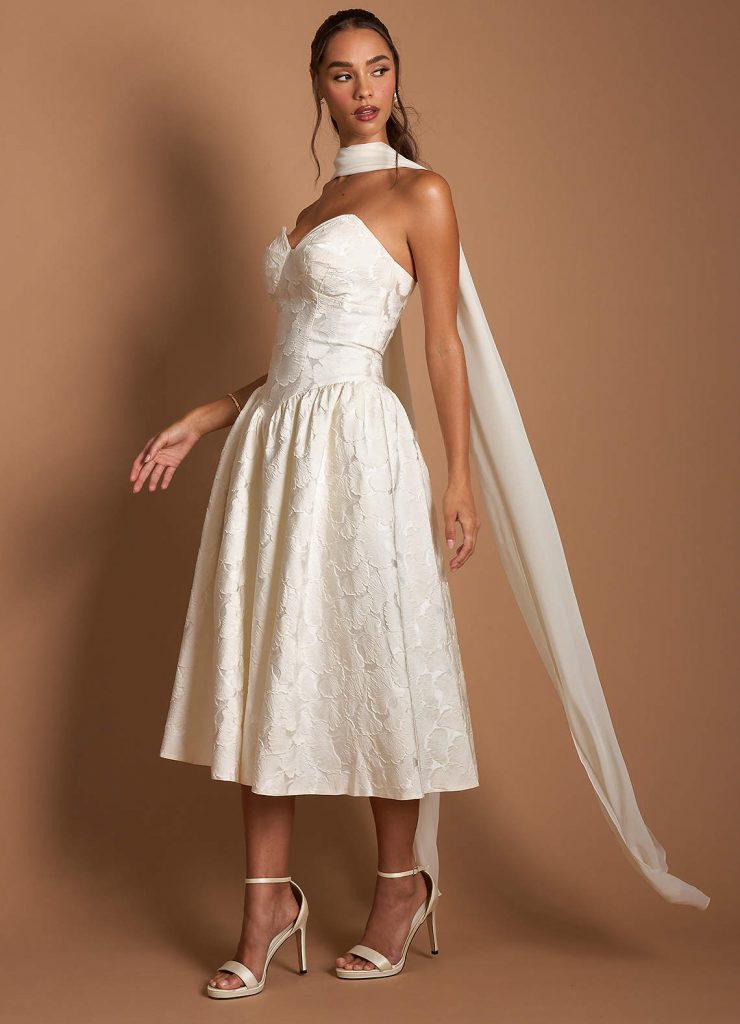
I noticed it at a formal outdoor wedding in Savannah last spring. Two women in nearly identical midi evening dresses. Same general silhouette, similar fabric, both attending the same ceremony and reception. One looked polished and intentional all evening — the dress read as a deliberate choice. The other looked like the dress was fighting her, and I couldn’t immediately figure out why.
I ended up watching them both across the reception trying to identify the difference. It came down — and I eventually confirmed this by standing close enough to see clearly — to two inches of hemline position and heel height. The woman who looked polished had a hem that hit just below her narrowest calf point. The other had a hem that bisected her widest calf point, which was creating a horizontal visual stop every time she moved.
That’s the specific problem with midi length. It asks more of the wearer than either short or floor-length styles because the hem has to hit the right place on the calf. Get it right and the dress reads as sophisticated. Get it wrong by half an inch and it looks like it wasn’t fitted correctly — even if every other element of the look is perfect.
| The rule before everything else: the hem should fall either just below the knee (reads modern and structured) or at the narrowest part of the calf, usually 3 to 4 inches above the ankle (reads as elongating and classic). The position that reads worst: the widest part of the calf. That’s the visual stop. That’s what creates the ‘frumpy midi’ impression people describe. |
|---|
Hemline Placement — This Is the Decision Everything Else Follows
Just Below the Knee — Modern and Structured
One to three inches below the knee reads as cocktail-adjacent: structured, contemporary, appropriate for semi-formal evening events. This position shows the widest part of the knee, creating a visual break that’s clean rather than leg-shortening.
This length works specifically well with structured fabrics — heavy crepe, formal satin — where the below-knee position reinforces the fabric’s formality. It also photographs well in seated shots because the hemline is at the knee or thereabouts, which creates the visual composition that most people are used to seeing in event photography.
Narrowest Calf Point — The Classic Elongating Position
Three to four inches above the ankle, at the narrowest calf point: this is the midi position that actually creates the elongating effect the dress length is known for. It frames the leg at its slimmest point, which visually extends the lower leg below the hemline. The foot and ankle become part of the visual composition in a way that reads as deliberately styled.
This position requires more careful shoe selection because more of the lower leg is covered. The shoe becomes the primary visual element the eye moves toward after the hemline — which means the wrong shoe here does more damage than the wrong shoe at the knee.
The Middle of the Calf — The One to Avoid
| A hemline that lands at the widest point of the calf creates a horizontal visual stop at the leg’s widest measurement. This is why midi dresses have a reputation for reading as ‘frumpy’ when they’re not styled correctly — the problem isn’t the length, it’s the specific position. A half-inch alteration up or down from this spot significantly changes the visual impression. If this is where your hem currently falls, the alteration is worth it. |
|---|
Shoes — The Most Consequential Styling Decision for Midi Length
Pointed-Toe Shoes — The Most Reliable Choice
A pointed-toe heel or flat extends the visual leg line from the hemline downward in a continuous taper. The pointed shape draws the eye from the hem toward the floor in a single visual movement. For any midi hemline position, pointed toe is the most reliable elongation tool — heeled or flat. Summer evening dresses in midi length at outdoor warm-weather events specifically benefit from heeled pointed-toe sandals — the pointed shape creates the elongation while the open-toe construction keeps the shoe scale appropriate for the lighter fabric.
Block-heeled pointed pumps are my consistent recommendation for formal midi events. The pointed toe creates elongation, the block heel provides stability for extended standing and dancing, and the silhouette reads as deliberately formal without requiring high-heel skill at hour four.
The Heel Height Decision — The Counterintuitive Answer
A midi doesn’t need a high heel the way a floor-length hem needs a heel to clear the ground. The hemline is fixed regardless of heel height. Which means heel height is purely a leg-proportion and comfort decision.
Here’s the counterintuitive part: a lower, more stable heel often looks better with a midi than a very high stiletto, because the viewer can see the full shoe and ankle below the hemline. A 2-inch kitten heel or block heel shows the entire shoe and ankle clearly, which actually creates a longer visual leg than a stiletto that’s partially obscured by the way you’re standing. I tested this with the same midi dress and three different heel heights last fall. The kitten heel photographed as longer-legged every time.
Round and Square Toes — Not Wrong, But Shorter
A round or square-toe shoe creates a horizontal visual stop at the foot. That stop isn’t technically wrong — it’s just visually shorter than the continuous taper of a pointed toe. If the event requires significant walking on uneven terrain and a wide-toe box is more practical, the round toe is fine. If leg length is the goal and the terrain allows it, pointed will always read as longer.
Hemline x Shoe Quick Reference
| Hemline Position | Best Shoe Shape | Heel Note | Avoid |
|---|---|---|---|
| Just below knee | Pointed-toe pump | Any height works | Round-toe bulky heel |
| Narrowest calf | Pointed or strappy | 2-3 inch block or kitten | Very chunky platform |
| Mid-calf (widest — avoid) | Pointed — always | Some heel helps elongate’, | Round-toe flats at this position |
| Ankle-grazing | Strappy sandal or pump’, | Heeled preferred’, | Sneakers or very casual shoe |
Proportions — Waist, Bodice, and the Fit Problem Nobody Talks About
Where the Waist Seam Has to Sit
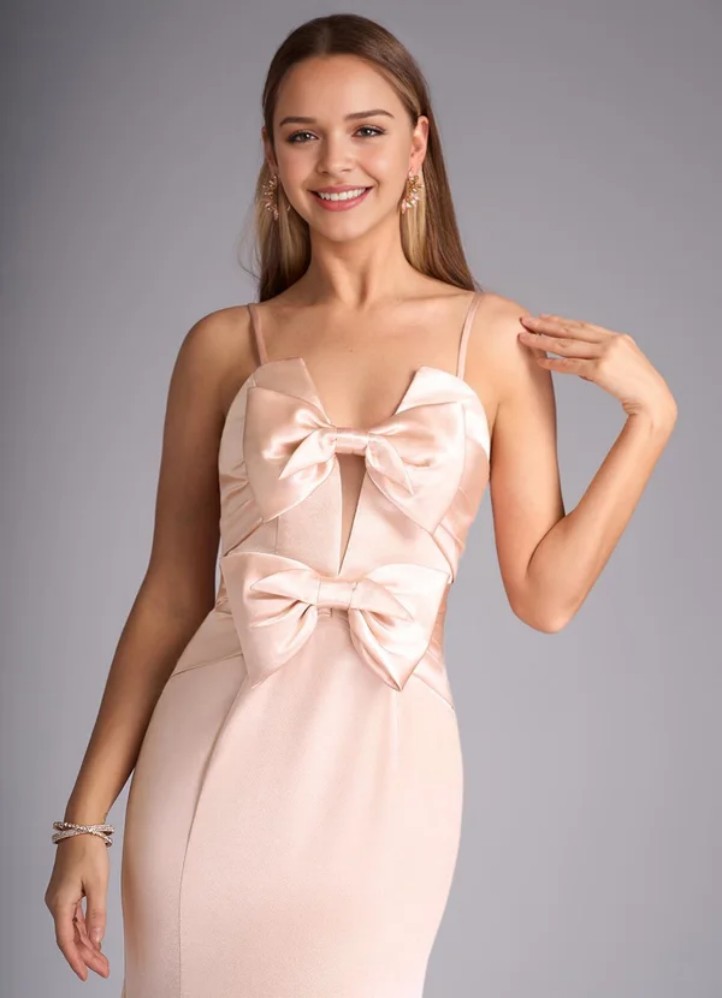
The waist seam should sit at or within half an inch of the natural waist — the narrowest torso point. When it sits correctly, the skirt reads as starting from the right place and the proportion of bodice to skirt feels balanced.
When the waist seam sits too low — common in standard sizing that doesn’t account for shorter torsos — it creates a dropped-waist effect that’s specifically more visible in midi length than in floor-length or short dresses. In a floor-length gown, the skirt is so long that a slightly low waist barely registers. In a midi, the skirt is short enough that the waist position reads as a proportional relationship between the bodice and the skirt — and that relationship looks wrong when the seam is even a half-inch off.
Petite Frames — Where Midi Length Is Most Demanding
For petite frames, petite evening dresses in midi length need the most careful hemline position check. A standard midi hemline on a shorter leg can hit at the widest calf point rather than the narrowest. This is the specific problem I saw in Savannah — one of those women was shorter than average, and the standard midi hemline was landing at exactly the wrong point on her leg. A half-inch shorter hem would have resolved it.
Monochromatic dressing — same color from neckline to hem — helps significantly with midi proportioning on petite frames by removing the color break that emphasizes where the hemline intersects the leg. One continuous color reads as longer.
Four Checks Before Wearing a Midi to a Formal Event
| 1 | Evaluate where the hem lands on your calf — with your actual event shoes on. The hem position changes with heel height, so you need to assess the midi in the shoes you’ll actually wear. Stand naturally and look at where the hem falls: just below the knee (structured, modern), narrowest calf point (elongating, classic), or widest calf point (unflattering — needs alteration). This check, done before the event in actual shoes, tells you definitively whether the dress needs hemming. It takes five minutes. The Savannah situation I described was a dress that had never had this check done. |
|---|
| 2 | Find the waistline seam and check it against your natural waist. Locate your natural waist — the narrowest torso point, typically an inch or two above the belly button. Check where the dress’s waist seam sits relative to this. Exactly at or just above: correct. More than half an inch below: the dress has a dropped-waist appearance that will affect how the entire skirt proportion reads. A waist seam that sits too low is harder to alter than a hemline — which is why catching it before wearing is more important. |
|---|
| 3 | Look at the full look from 10 feet away — or take a photo. Step back, or take a photo and evaluate from the screen. Check whether the shoe creates a visual continuation of the leg line from the hem downward. Pointed toe: creates continuation. Round or square toe: creates a horizontal stop. The stop shortens the visual leg. If the goal is leg length — and with midi, it usually is — pointed toe reads measurably longer. This evaluation is harder to do close-up in a mirror than it sounds. |
|---|
| 4 | Walk in a normal stride and check whether the dress restricts movement. A midi should move with your stride, not against it. A fitted skirt without significant flare can restrict the natural step length. Test this by walking across a room normally. A midi that requires you to shorten your steps reads as awkward in motion — exactly the thing you’re trying to avoid with careful hemline placement. A-line or flared midis accommodate a natural stride; fitted column midis may need a small slit or additional ease. |
|---|
Fabrics That Make Midi Evening Dresses Work
Structured Fabrics — Crepe and Heavy Satin
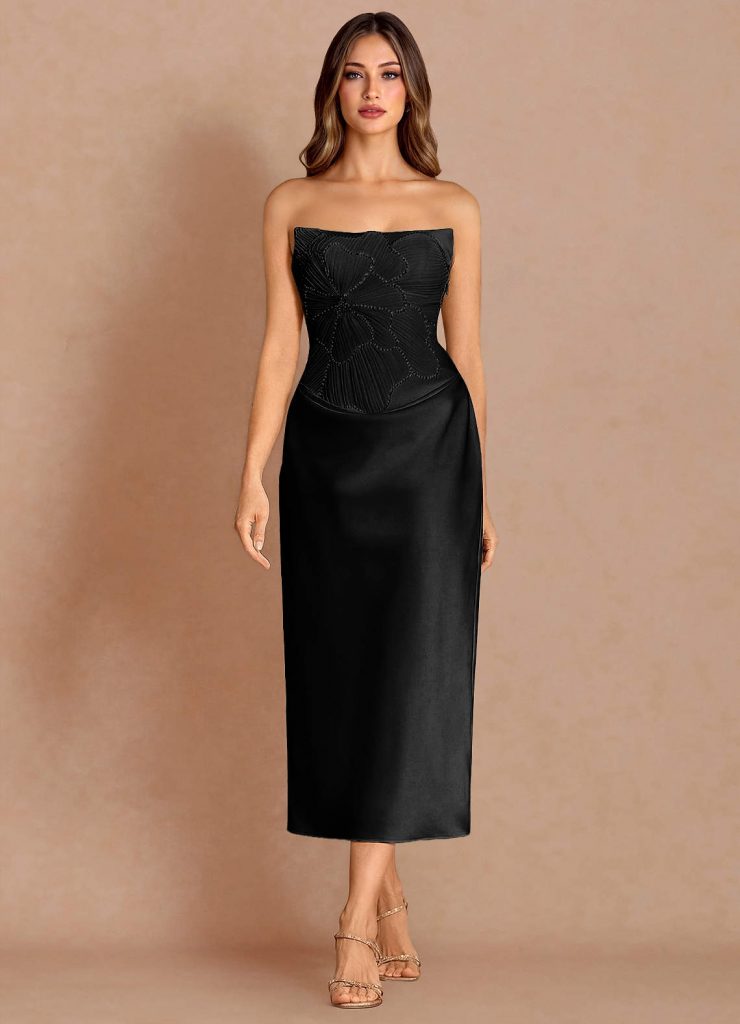
Quality stretch crepe holds a clean hemline in motion and photographs as polished as formal fabrics get. Elegant black evening dresses in crepe at midi length are the most reliable high-formality midi combination available. Heavy satin at midi length reads as specifically event-appropriate but requires the waist seam to be precise — satin shows fit imprecision in ways crepe doesn’t.
Fluid Fabrics — Chiffon and Lightweight Silk
Layered chiffon in a soft jewel tone or neutral creates beautiful fluid movement at midi length — specifically good for outdoor or warm-weather formal events where a structured fabric would feel heavy. The limitation: chiffon doesn’t hold a perfectly clean hemline the way crepe does. The hem needs to be weighted or hemmed with a specific finish that keeps the edge from curling or shifting. Summer evening dresses in layered chiffon midi silhouettes are consistently one of the strongest warm-weather formal options.
Closing Thoughts
The woman in Savannah with the polished midi — I asked her about it at the end of the reception. She said she’d had it hemmed twice. The first alteration was by a tailor who hadn’t asked what shoes she was wearing. The second was by someone who did, who hemmed it while she was wearing the block-heeled pumps she had on that evening.
Two inches of alteration. That’s what the difference between a midi that works and a midi that fights you often comes down to. Azazie’s full evening dress collection includes midi options in crepe, chiffon, and satin across A-line, column, and mermaid silhouettes in sizes 0 to 30, with made-to-order options available for the fit precision that midi length specifically requires.
Frequently Asked Questions
Where exactly should a midi evening dress hemline fall?
Two flattering positions: just below the knee (1 to 3 inches below), which reads modern and structured, or the narrowest calf point (typically 3 to 4 inches above the ankle), which reads as elongating and classic. The position that reads worst is the widest calf point — it creates a horizontal visual stop that shortens the leg. A half-inch alteration from the widest point to either of the two better positions makes a visible difference.
What shoes work best with midi evening dresses?
Pointed-toe shoes — heeled or flat — are the most reliable choice. The pointed toe draws the eye in a continuous line from hem to floor. Block heels at 2 to 2.5 inches are the most practical formal option: height and elongation with event-appropriate stability. Strappy heeled sandals work well for warm-weather formal contexts. The counterintuitive note: a lower stable heel often photographs as longer-legged than a very high stiletto because the full shoe and ankle are visible.
How does waist seam placement affect a midi dress?
More visibly than in floor-length or short dresses. The waist seam should sit at the natural waist. When it sits too low, the dress reads as a dropped waist — and in midi length, the bodice-to-skirt proportion relationship is short enough that the waist position reads as the primary proportional relationship in the dress. A half-inch low is more visible here than in a floor-length gown where the skirt length absorbs the error.
Can petite women wear midi evening dresses?
Yes, with the right hemline position. On a shorter leg, standard midi lengths can land at the widest calf point rather than the narrowest — which is the position to avoid. A below-knee hemline often works better for petite frames because it avoids the problem entirely. Monochromatic dressing and pointed-toe shoes both help maintain visual length.
What fabrics work best for midi evening dresses?
Quality stretch crepe for a clean hemline and reliable motion behavior. Heavy satin for high-formality contexts where the reflective surface is doing visual work. Layered chiffon for outdoor and warm-weather formal events where the fluid movement reads correctly for the setting. The fabric determines how the hem behaves in motion: structured fabrics hold the hemline cleanly, fluid fabrics create movement but need a weighted hem construction.
Can midi evening dresses work for black-tie events?
A midi in quality structured fabric — heavy satin, formal lace, velvet — can work for black-tie optional or creative black-tie. Strict black-tie typically expects floor-length. The fabric and construction quality are the primary signals of formality at midi length. A well-constructed midi in formal fabric reads as more formal than a poorly constructed floor-length dress in casual fabric — but it still reads as less formal than floor-length to most event contexts.