
Simple White Dresses for Graduation:Why Less Works Better on the Day
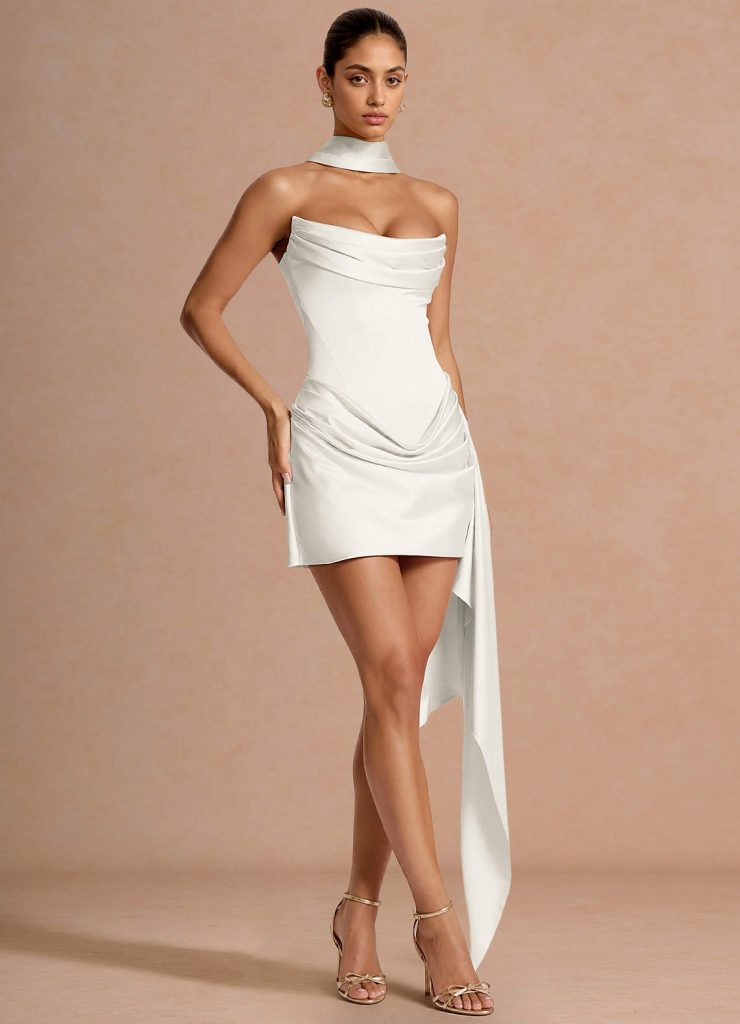
Simple gets underestimated in graduation dress shopping. Most guides push toward “something that stands out,” as if simpler choices are settling. But simple white dresses for graduation are consistently the best-photographing option because graduation photography has specific characteristics that favor clean over elaborate: wide-angle stage shots, mixed indoor and outdoor lighting, multiple photo scenarios in one day.
A simple dress done well — quality fabric, clean silhouette, good fit — photographs better than a more elaborate dress in cheap fabric or a poor fit. That’s not an opinion, that’s just how graduation photography works. The camera sees fabric quality and clean lines before it registers embellishment detail.
This guide is about what “simple” actually means in practice, which fabric choices make simple look expensive rather than underdressed, and how to style a plain white dress so it reads polished rather than minimal.
Why Simplicity Works Better at Graduation Photography
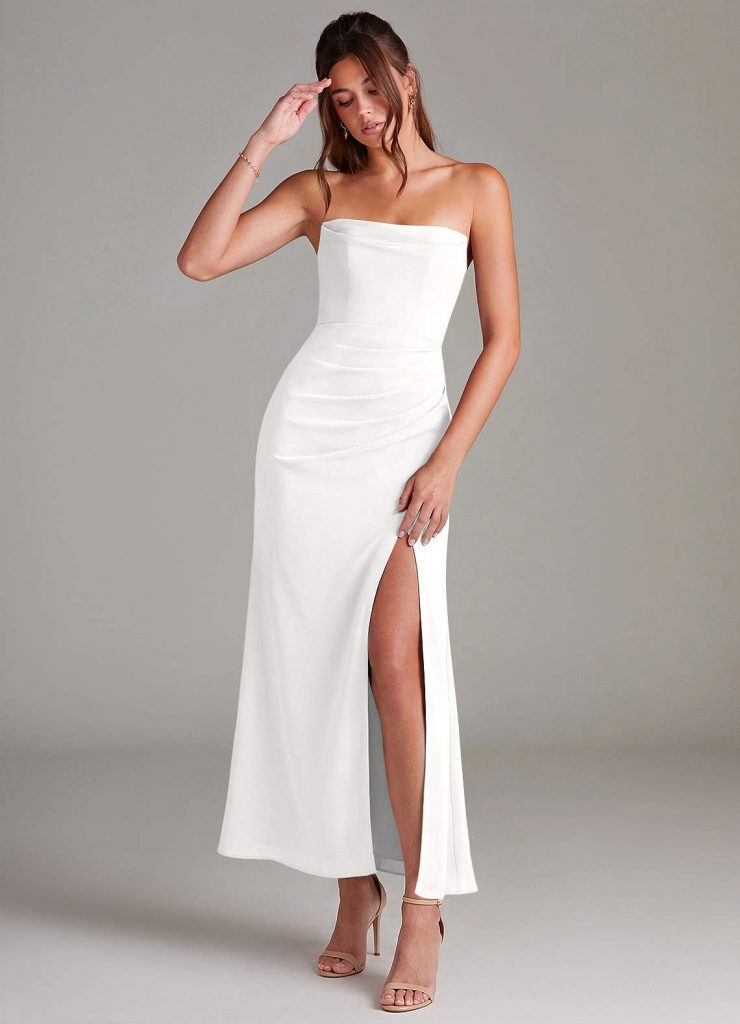
Three distinct photo scenarios happen on graduation day, and simple dresses outperform elaborate ones in at least two of the three. Here’s why.
| 🏛 WIDE STAGE SHOT Simple Wins Clearly From 30+ feet, clean silhouette and quality fabric read as polished. Embellishment detail disappears. Structure and proportion are what register at distance. |
📸 CLOSE PORTRAIT Both Can Work Close-up photography benefits from quality fabric finish. Simple dresses let the face and the regalia be the focal point. Elaborate details can compete with honor cords. |
🎉 POST-CEREMONY PARTY Both Work Equally After the robe comes off, both simple and detailed dresses get their full reveal. Styling choices (accessories, shoes) matter more here than the dress itself. |
|---|
The ceremony photography is where simple dresses win the most clearly. The ceremony is the primary photographic record of graduation — it’s what the professional photographer captures, what the family records from the audience, and what ends up framed. Simple works better in that scenario.
Simple Doesn’t Mean Cheap — What Makes Simple Look Expensive
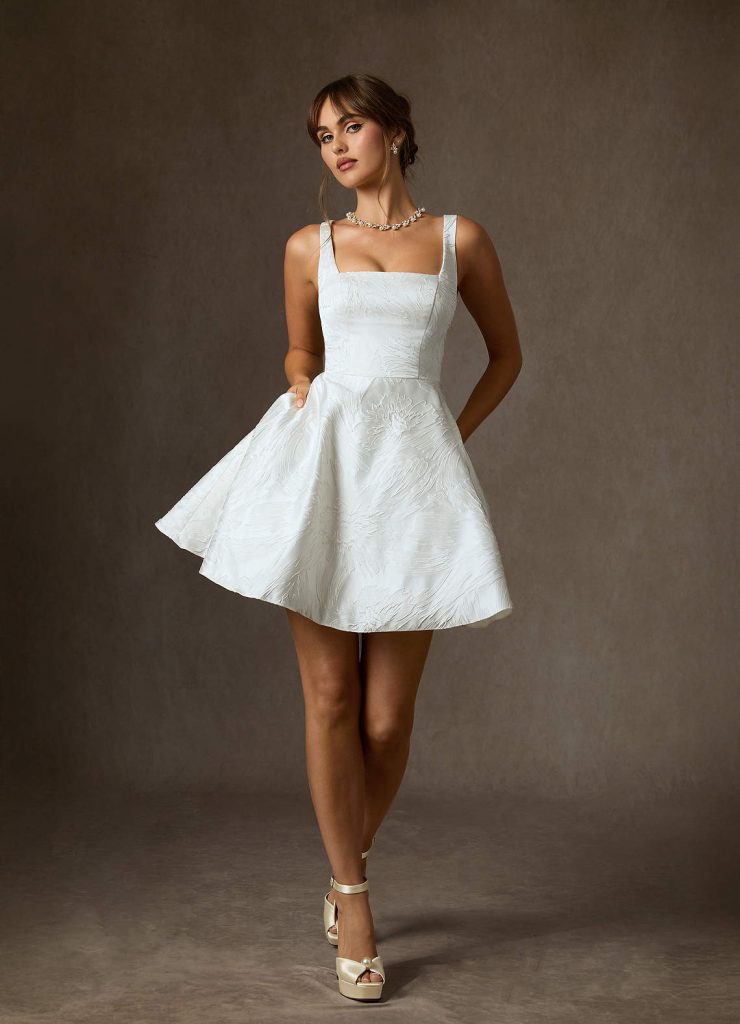
Here’s the important distinction. A simple white dress in poor fabric looks underdressed. The same silhouette in quality crepe or structured satin looks polished and intentional. The simplicity has to be backed by fabric quality to work for graduation.
| The simple dress rule: the fabric does the work that embellishment doesn’t |
|---|
| Best Structured Crepe — Holds its shape all day, matte finish photographs without glare, resists wrinkles after hours of sitting. Simple silhouettes in crepe read expensive. |
|---|
| Very Good Soft Stretch Crepe — Same properties as structured crepe but more comfortable for long ceremonies. Slightly more movement in the fabric. |
| Good Matte Satin — Soft sheen that reads elegant without the glare problem of mirror-finish satin. Works better in simple silhouettes than in elaborate ones. |
| Good Quality Cotton Blend — Breathable and comfortable. Works particularly well for simple A-line styles in outdoor spring ceremonies. |
| Avoid Thin Polyester / Jersey — Simple silhouette in cheap fabric = underwhelming at ceremony. The simplicity has nothing to carry it if the fabric is visibly low-quality. |
A simple a line white graduation dress in quality stretch crepe is genuinely one of the most polished graduation looks available. It’s not exciting, and that’s the point. It photographs clean at every camera distance, holds up through a long day, and doesn’t compete with the academic regalia that’s already doing a lot of visual work.
How to Style a Plain White Graduation Dress So It Looks Polished
This is the question most people have when they choose a simple dress: how do you make sure it reads as polished and intentional rather than just underdressed? The answer is in the styling. A plain white dress is a canvas that relies entirely on the styling choices around it.
| 1 HAIR |
Hair that works with the graduation cap is the biggest single styling challenge with simple dresses. Low side-swept waves, a sleek low bun, or a low ponytail at the nape all look intentional. High updos can tilt the cap awkwardly. Down with soft waves works beautifully. |
|---|
| 2 JEWELRY |
One piece of jewelry that earns its place. Gold studs or pearls in the ears frame the face under the cap. A thin pendant necklace if the neckline has room. A simple watch for a polished, professional touch. The graduation regalia — stoles, cords, tassel — is already doing a lot of decorating. |
|---|
| 3 SHOES |
Nude, white, or metallic gold. Nothing that creates a strong color contrast at the shoe that pulls the eye in full-body photos. Block heels for outdoor venues, kitten heels or pointed-toe flats for indoor. Both photograph polished alongside a simple white dress. |
|---|
| 4 BAG |
Small or none during the ceremony. A slim clutch after. For the ceremony specifically, a family member’s bag is more practical than carrying your own. Post-ceremony, a small metallic or neutral clutch completes the look without competing with it. |
|---|
| 5 NAILS |
Sounds minor but shows in close-up portrait shots. Neutral, soft pink, or white nail color keeps the clean aesthetic consistent. Dark nails can create a jarring contrast in hand-close-up photos when you’re accepting the diploma. |
|---|
Which Necklines Work Best on Simple White Dresses
With a simple dress, the neckline carries more visual weight than it does on an elaborate one. A clean, intentional neckline is what stops a simple dress from looking like it’s trying to look plain. Here’s what works with which accessories.
| SQUARE NECK ✓ Wear: Pearl studs or small gold studs ✗ Skip: Statement necklace — competes with the clean horizontal line The most consistently polished graduation neckline on a simple dress. Frames the face cleanly and sits flat under the robe. |
V-NECK ✓ Wear: Thin pendant necklace or studs only ✗ Skip: Chunky statement necklace that fills the V Elongates the neck beautifully in close-up portraits. The V gives space for one small pendant if you want something at the neckline. |
|---|---|
| SCOOP NECK ✓ Wear: Pearl or small stud earrings ✗ Skip: Very heavy necklace — fights the soft neckline shape Soft and elegant. Works for every ceremony type. Frames the face without the sharpness of a square neckline. |
HALTER / COWL ✓ Wear: Earrings only — no necklace ✗ Skip: Any necklace at all — competes with the halter structure The halter tie or cowl fold is the detail. A necklace always competes with it. Statement earrings are the styling move here. |
For college graduation dresses at formal university commencements, a square or V-neck in a simple crepe dress with pearl or gold studs is genuinely one of the cleanest, most photograph-consistent graduation looks available. No competing elements. The regalia does the ceremony work. The face is the focus.
What “Simple” Means for Different Graduation Settings
Simple means slightly different things at different ceremony types. What reads as appropriately understated at a doctoral hooding is different from what works at a casual outdoor high school ceremony. Understanding the setting helps calibrate how minimal to go.
| HIGH SCHOOL + OUTDOOR ▸ Simple A-line or fit-and-flare in cotton or chiffon ▸ Slightly more room for playful detail — a subtle ruffle or eyelet is still “simple” ▸ Natural light is forgiving — simple reads fresh, not bland, outdoors ▸ Breathable fabric matters most — outdoor heat under a heavy robe is real |
COLLEGE + UNIVERSITY INDOOR ▸ Simple A-line or sheath in crepe or structured satin ▸ Nothing competes with academic hoods, honor cords, and doctoral stoles ▸ Stage lighting is the variable — matte fabric over shiny for indoor auditoriums ▸ Simple reads as intentional and professional at university commencements |
|---|
| ✨ THE SIT TEST — MOST OVERLOOKED CHECK FOR SIMPLE DRESSES Simple dresses often have less structure than elaborate ones. Put the dress on, sit in a chair for five minutes, then stand. Does it smooth back out or stay wrinkled? A simple crepe dress that holds its shape after sitting looks polished in ceremony photos. A simple jersey dress that wrinkles after 20 minutes of sitting doesn’t. |
|---|
Browse modest graduation dresses if you’re looking for simple styles with more coverage — many are designed with conservative ceremony settings in mind and offer clean silhouettes in quality fabrics.
Frequently Asked Questions
Is a white dress appropriate for graduation?
White is essentially the expected choice at US graduation ceremonies, simple or otherwise. Simple white in particular works because it doesn’t compete with the graduation regalia, reads clean in every type of ceremony photography, and photographs polished at every camera distance. Check your specific school’s dress code, but a simple white dress is appropriate for virtually every graduation type.
Why do Americans wear white for graduation?
The tradition dates back to the 1880s and 1890s, particularly at women’s colleges like Wellesley and Smith, where white attire created a uniform dignified look for graduating classes. It became associated with new beginnings and academic achievement. Simple white in particular photographed well even in early photography — part of why the tradition persisted through every decade since.
How do you actually look good at graduation?
Start with a well-fitted dress in quality fabric. That’s 80% of it. Steam the dress the night before. Do the sit test. Match your hair to the graduation cap rather than fighting it. One piece of jewelry that earns its place. Shoes that are stable for the venue. The rest follows from those foundations.
How do you style a plain white dress for graduation?
One accessory decision at a time. Hair down in soft waves or a low bun. One earring — pearl studs or small gold — that frames the face. Nude or metallic shoes that don’t create visual competition at the shoe. A small clutch after the ceremony. The styling goal is to make the simple dress look intentionally simple, not accidentally plain.
Why is white popular for graduation?
A combination of tradition and photography logic. White has been the graduation standard for over 130 years in the US, but it’s maintained dominance because it photographs better than most other colors under the combination of lighting conditions graduation involves. White reflects stage spotlights, works in outdoor afternoon sun, and reads clearly in flash photography from a family in the audience at row 30.
What is the best color to wear to graduation?
White is still the most photographically consistent choice, simple or otherwise. Ivory and cream are close alternatives that photograph similarly well. Very pale pastels can work but sometimes lose clarity in stage lighting conditions. Saturated or dark colors photograph differently under stage spotlights and can clash with some gown colors. For a simple look specifically, crisp white or ivory are the most reliable choices.
When did people start wearing white dresses for graduation?
The tradition became widespread in the US in the 1880s and 1890s, largely driven by women’s colleges that wanted a dignified, unified look for graduating classes. White attire was also associated with the suffragette movement, which gave it additional cultural significance for women graduates. Simple white styles have been part of this tradition from the beginning — the original graduation dresses were not elaborate.
What does white mean at graduation?
New beginnings, the end of one chapter and the start of the next. Academically, it’s also associated with the “blank slate” — the clarity and open possibility that follows completing a degree. Simple white carries this symbolism more clearly than a heavily embellished style because the simplicity itself communicates the same clean-start message the color does.
Can graduation guests wear white?
The general convention is no — white is the expected color for graduates, and guests wearing white can create awkward photos where guests and graduates aren’t visually distinct. Guests are better off in soft neutrals, pastels, or prints that read as festive and appropriate without competing with the graduates’ expected attire. A white-based floral print is a common guest compromise.
What are the top three graduates called?
Valedictorian (highest GPA, usually delivers the commencement address), Salutatorian (second highest, often also has a speaking role), and then it varies significantly by institution. Some schools use Summa Cum Laude, Magna Cum Laude, and Cum Laude as the tiered honor system. Others have Class Historian or Speaker roles. The specific naming depends entirely on the institution.
What color is typically used for graduation?
Graduation robes are most commonly black or navy, though some schools use specific colors tied to institutional identity. The dress worn underneath by female graduates is most commonly white — a tradition so widespread it’s essentially the default across US high school and college ceremonies. Simple white particularly, because clean simple styles were what created the tradition in the first place.