
Petite Cocktail Dresses for Wedding Guests: What Actually Fits and Flatters
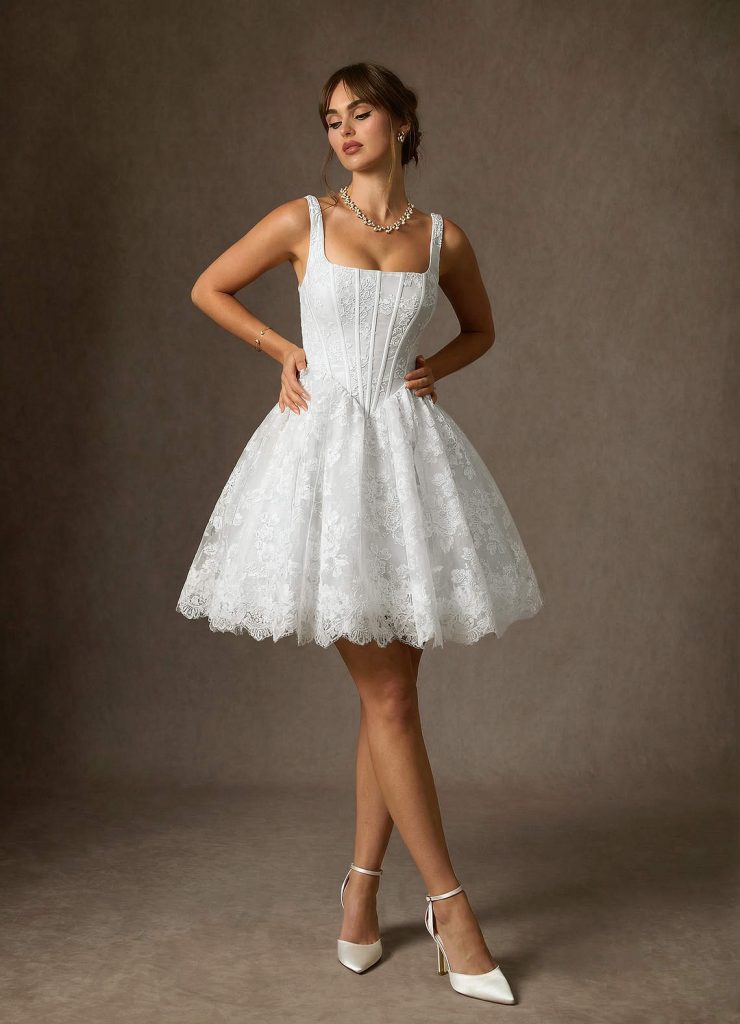
My cousin is 5’0″ and has been attending weddings at a rate of about four per year for the last decade. She has — and I’ve watched her do this — returned three dresses still tagged because the waist sat somewhere around her hips and the hem hit mid-calf instead of at or above the knee. Not because the dresses were the wrong style. Because they were cut for a body with different proportions and no one mentioned this when she bought them. Shopping for petite dresses for wedding guests in standard sizing is a specific kind of frustrating, and the frustration is almost always proportional — literally.
Get those three right and the dress code question becomes easy. Here’s what I’ve learned watching this happen repeatedly.
| The short version: A-line or fit-and-flare in satin or chiffon, hemmed to your height in the shoes you’ll actually wear. That combination handles most cocktail wedding dress codes for most petite frames without further deliberation. Everything below is the reasoning — and the specific exceptions that matter. |
|---|
Proportions — Why Petite-Cut Dresses Look Different From Hemmed Standard Sizes
What Petite-Cut Actually Means
A true petite-cut dress adjusts the waist placement, shortens the torso, and — depending on the construction — adjusts the sleeve length and shoulder width. The result is that the waist seam actually lands at or near your natural waist instead of somewhere between your waist and hip. This distinction is visible from across a room.
A hemmed standard-size dress isn’t the same thing. You take up the length, but the waist placement is still wrong, the bodice proportions are still off, and you’ve spent money altering something that reads as ‘close but not quite’ instead of tailored. My cousin has several of these in her closet. They’re not bad dresses. They just don’t fit the way a dress sized for her frame does.
The Vertical Line — What You’re Always Working Toward
Every silhouette choice, color choice, and accessory choice for a petite frame is working toward the same goal: the eye travels up, not across. V-necklines do this. A-lines that flare from the natural waist do this. Monochromatic dressing does this. What works against it: wide horizontal bands across the midsection, very large prints at the widest part of the body, and anything that visually cuts the torso in half.
This isn’t a complicated rule. But it’s the organizing principle that makes every other decision simpler once you’ve accepted it.
Silhouette — A-Line First, Then Work Backward From There
A-Line — Consistent, Reliable, and Actually Right
An a line wedding guest dress cinches at the natural waist and flares gently outward from there. For petite frames specifically: this creates an elongating effect because the eye travels along the flare rather than stopping at the widest point of the body. In satin or chiffon at cocktail length, it reads as genuinely event-appropriate without requiring much accessory work to finish the look.
The counterintuitive thing about A-line hemlines for petites: slightly above the knee works better than at the knee. The above-the-knee hem shows more leg, which reads as taller. A hem that grazes the knee can shorten the visual line on a shorter frame in a way that a half-inch above doesn’t. I’ve watched this be the only difference between ‘looks great’ and ‘looks a bit off’ on the same person in the same silhouette.
Fit-and-Flare — More Waist Definition, More Visual Impact
Fit-and-flare fits close through the bodice and hips, then flares. It creates more waist definition than a standard A-line. For petite frames, this works specifically because it emphasizes the narrowest point of the body and then creates movement below it — the overall effect is more shape without adding visual width.
Needs fabric with enough give to move — structured fabrics in a fit-and-flare can feel restrictive after a few hours of sitting and dancing. Check the fabric composition before buying.
Wrap Dress — The One That Adjusts to Uncertainty
A wrap dress has an adjustable neckline — the V depth changes based on how you tie it. For petite frames uncertain about proportions or sizing: wrap dresses are forgiving in a specific way because you can adjust the fit at the bust and waist after you’ve put it on. The V-neckline also creates a vertical line down the front of the body, which is doing the right thing for a petite frame.
Shift — When the Fabric Carries All the Weight
| A shift dress has no waist definition. For petites, this means the fabric is doing all the formality and proportion work on its own. A shift in cheap or lightweight fabric reads as underdressed at a cocktail wedding. A shift in quality crepe or structured satin reads as intentionally chic. If you’re going shift, the fabric has to be genuinely good. There’s no silhouette structure to compensate. |
|---|
Silhouette Quick Reference for Petite Cocktail Dresses
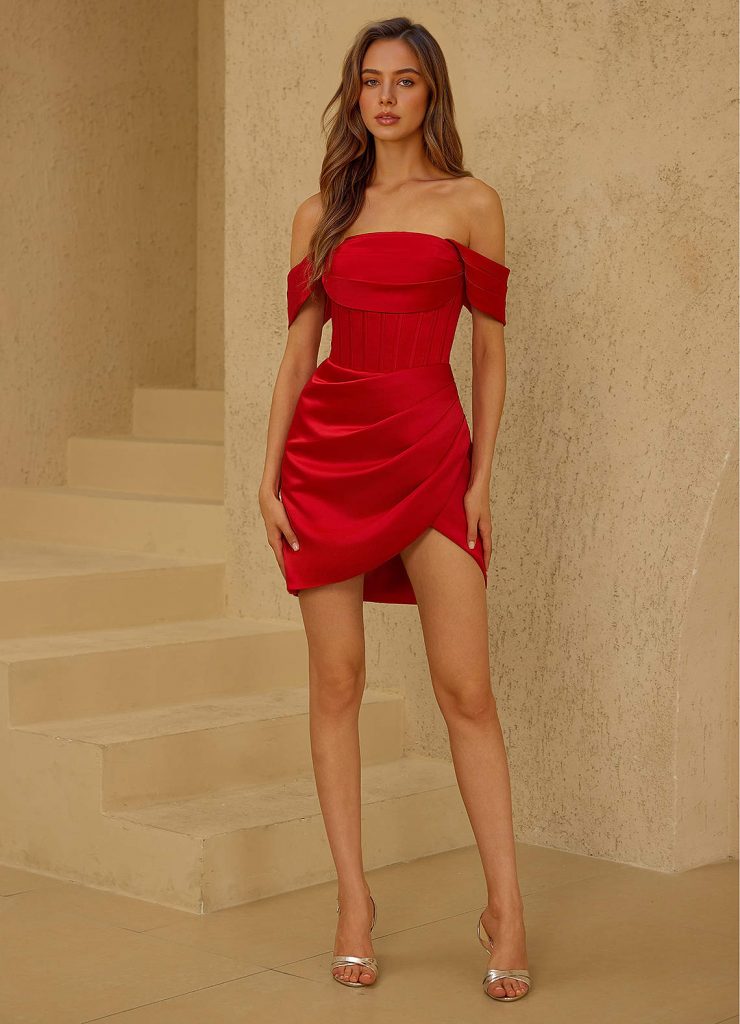
| Silhouette | Best For | Key Petite Note |
|---|---|---|
| A-line | Most venues and body types’, | Hem slightly above knee shows leg — reads taller than at-knee’, |
| Fit-and-flare’, | Semi-formal to formal cocktail’, | More definition — check fabric allows movement after hours of wear’, |
| Wrap dress’, | Most cocktail settings’, | Adjustable fit — good when proportions are uncertain’, |
| Shift’, | Casual to semi-formal cocktail’, | Fabric does all the work — quality fabric is non-negotiable here’, |
| Empire waist’, | Any cocktail setting’, | High waist placement elongates the lower body significantly’, |
Fabric — Drape Over Structure, With One Exception
Satin — The Most Formal-Reading Petite Cocktail Choice
Satin drapes well and photographs with a richness that reads as specifically event-appropriate. For petite frames: the natural weight of quality satin creates a smooth continuous line rather than bunching or pulling anywhere, which is exactly what you want when proportions are tight. In a jewel tone or deep neutral, a satin cocktail dress at a wedding reads correctly for the dress code.
The construction point: quality satin that was cut for petite proportions drapes differently from standard-size satin taken up at the hem. The fabric knows where it’s supposed to be. This sounds abstract and is immediately visible in photos.
Chiffon — Movement and Lightness, With One Real Caveat
Chiffon is romantic and moves beautifully. For outdoor or spring-summer cocktail weddings, it’s one of the most consistently flattering options for petite frames because the lightness of the fabric doesn’t add visual weight. But — and this is the caveat — single-layer light chiffon can be sheer in outdoor lighting or under camera flash. Check that the wedding guest dress you’re considering has adequate lining. ‘Lined’ and ‘fully lined’ mean different things depending on the construction.
Velvet — For Fall and Winter Cocktail Weddings, Specifically
Velvet on a petite frame reads warm and seasonal without being overwhelming when the silhouette is right. An A-line or fit-and-flare velvet cocktail dress in burgundy or deep plum for a November wedding: that combination looks like you knew what you were doing. Heavy velvet in a very full or stiff silhouette is the version that can overwhelm — avoid very structured velvet in ballgown-adjacent shapes and you’ll be fine.
Crepe — The Practical Option That Doesn’t Get Enough Credit
Quality crepe holds its structure, photographs as clean and deliberate, and resists the wrinkle problem that shows up after a dinner seating. It doesn’t have satin’s sheen or velvet’s texture — but for petite frames, a well-cut crepe A-line in a jewel tone can look more polished than a more dramatic fabric that was fighting the proportions.
Accessories — Scale Down, Draw the Eye Up

Jewelry — Earrings Are the Strongest Move for Petite Frames
Drop earrings and chandelier styles draw the eye upward along a vertical line toward the face. For petite frames, this is exactly the direction you want. A wide statement necklace that sits horizontally across the collarbone has the opposite effect — it creates a visual break across the torso that emphasizes width rather than height.
One focal point — still the rule. Bold earrings with a minimal or absent necklace. Simple earrings with a delicate chain if the neckline has space. The earrings carry more visual responsibility for petite frames than they do for taller guests, so the choice matters more.
Shoes — Block Heels and Pointed-Toe Flats
Block heels add height without instability. They’re formal enough for cocktail attire and your feet actually still work at hour four. For outdoor venues: wedges, which handle terrain better than stilettos. For the ‘heels aren’t happening tonight’ decision: pointed-toe flats rather than round-toe. The pointed toe creates a visual leg-lengthening effect that round-toe flats don’t — specifically useful for petite frames. Off the shoulder wedding guest dresses paired with pointed-toe kitten heels is one of the cleaner petite silhouettes for cocktail events.
Very chunky platform shoes add a lot of visual weight at the foot that can read disproportionate on a petite frame. The platform compensates for the height loss but creates a different proportion problem at the base.
Bag — Small and Proportional
A minaudière, small structured clutch, or delicate chain pouch. Nothing larger. An oversized bag visually competes with the dress on a petite frame in a way it doesn’t on a taller woman — the bag and the body are now roughly the same scale, and the proportions read as off.
Outerwear — Cropped, Not Full-Length
A cropped jacket or bolero hits at the natural waist and maintains the vertical line of the dress underneath. It also looks intentional as outerwear rather than like you grabbed something because you were cold. A full-length coat or floor-length wrap covers the entire dress silhouette and changes the proportion of the whole look. For strapless wedding guest dresses specifically: a cropped shrug or delicate lace bolero sits correctly at petite scale in a way that a draped full wrap doesn’t.
Before You Buy: Three Checks Worth Doing
| 1 | Confirm whether the dress is a true petite cut or a standard size that can be hemmed. These are different products. A true petite cut adjusts the waist placement, torso length, and proportions. A standard size that you hem shortens the length but leaves the waist placement, bodice proportions, and shoulder width wrong for a shorter frame. If the dress listing doesn’t specify petite sizing, ask before buying or check the measurements against your own. The fit difference between these two options is visible and worth the extra step. |
|---|
| 2 | Check where the hemline actually falls on your body — not on the model. Models in dress photos are typically 5’9″ to 5’11”. If the hem looks like it hits above the knee in the photo, it may hit at or below the knee on a 5’2″ frame. Find the exact hem length in centimeters or inches in the product description and compare it to where that length falls on your specific body. This one step prevents the most common petite fit disappointment. |
|---|
| 3 | Decide on shoes before finalizing the hemline. The hem should be finalized in the shoes you’ll actually wear that evening. A 2-inch heel changes where the hem hits relative to a flat or kitten heel. For cocktail dresses especially — where the hemline is already shorter and more precise — that difference is visible. Lock in the shoes first, try on the dress with those shoes, then decide whether the hem needs adjustment. |
|---|
Closing Thoughts
My cousin’s most recent wedding — May, Charleston, cocktail attire, outdoor ceremony transitioning to an indoor reception — she wore a petite-cut fit-and-flare in deep burgundy satin, hemmed to exactly where she wanted, with pointed-toe block heels and drop earrings. No alterations.
Frequently Asked Questions
What fabrics work best for petite cocktail dresses at weddings?
Satin for a formal sheen and clean drape that reads event-appropriate without adding visual weight. Chiffon for lightweight romantic movement — check that it’s adequately lined for cocktail formality. Velvet specifically for fall and winter events, in a silhouette that doesn’t overwhelm the frame. Crepe for a structured matte option that holds up across a long evening. The thing to avoid: heavy stiff fabrics that add volume rather than draping with the body.
Can a petite woman wear a midi dress to a cocktail wedding?
Yes, but heel height matters more with a midi on a petite frame than on a taller one. A mid-calf hem can shorten the visual line, so pairing with a heel or at minimum a pointed-toe flat keeps the leg line elongated. Where the hem actually falls on your body — not the model’s — is the question to answer before buying.
What’s the best silhouette for petite cocktail dresses?
A-line is the most consistently reliable. It defines the waist and flares outward, creating an elongating effect for petite frames. Fit-and-flare is a strong second choice with more waist definition. The silhouette to be careful with: anything with a wide horizontal waistband or seam that cuts across the midsection visually shortens a petite frame rather than elongating it.
What shoes work best with petite cocktail dresses?
Block heels for stable height. Wedges for outdoor venues where stilettos sink. Pointed-toe flats — not round-toe — when heels aren’t happening, because the pointed shape creates a visual leg-lengthening effect. Avoid very chunky platforms that add disproportionate visual weight at foot level.
Can I wear a floral dress as a petite wedding guest?
Yes, but print scale matters. Large bold florals can overwhelm a shorter dress where there’s less fabric for the pattern to distribute across. Smaller or medium-scale floral prints in chiffon or lightweight fabrics photograph beautifully. Moody darker florals work well for fall and evening cocktail events. Light pastel delicate prints for spring and summer daytime weddings.
Can petite women wear black to a cocktail wedding?
Yes — and it’s one of the more flattering choices for petite frames specifically. Black creates an unbroken vertical color line from shoulder to hem, which reads as taller. Add warm accessories — gold jewelry, a jewel-colored clutch, a pointed-toe shoe in a warm metallic — to keep it festive rather than somber.