
Long Black Formal Dresses: Shoes, Tailoring, and Proportion Tips That Work
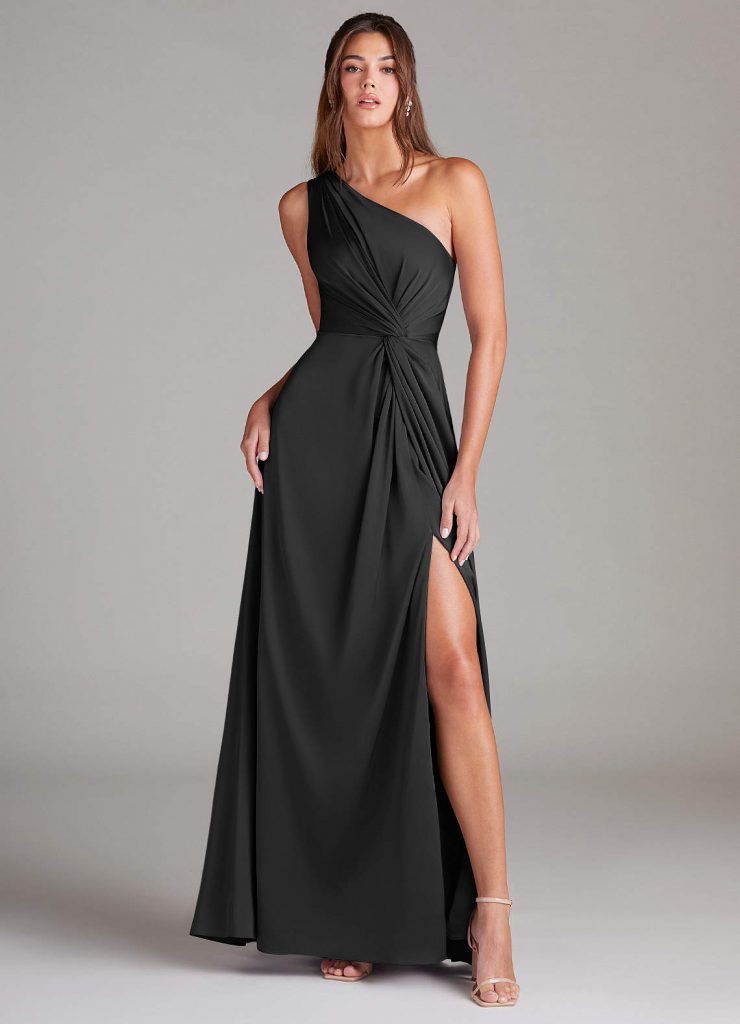
The hemline. That’s the thing most people get wrong with long black formal dresses. Not the silhouette, not the accessories — the hemline. A pooling hem on a black floor-length gown looks like you’re wearing someone else’s dress. And because the fabric is black, there’s nowhere for that mistake to hide.
I’ve watched this play out at formal events more times than I can count. Great dress, great fabric, completely undermined by two extra inches of fabric dragging behind the ankle. It’s an easy fix — but it has to be done before the event, not the morning of.
| THE CORE PROBLEM A long black gown covers almost the entire body. That means the silhouette, shoe, and hemline placement carry all the visual weight. Get one of those wrong, and the whole look reads as heavy or unkempt. Get all three right, and it’s one of the strongest formal looks available. |
|---|
The Role of Shoes in Long Black Formal Dresses
Why Shoes Come First
Shoes aren’t an afterthought with a long black gown. They’re the foundation decision. The heel height determines where the hemline needs to sit. Change the shoes, and you’ve changed the hemline. Which means if you haven’t decided on the shoes before the tailoring appointment, you’re in trouble.
Footwear choice for long formal gowns is the starting point of the entire proportion calculation — not the finishing touch. The height of the heel directly affects how the hem hits, how the body appears, and whether the dress reads as formal or sloppy.
Heels vs. Flats — the Actual Answer
Heels for long black formal gowns. That’s the default answer. Not because flats are wrong — but because at floor length, the hem needs a specific amount of lift to avoid pooling. Without heel height, the hem has to be tailored shorter, which changes the silhouette. And a long black gown that’s been shortened to accommodate flats doesn’t read the same as one that grazes the floor at full length.
Flats can work. An embellished pointed-toe flat for a garden wedding or outdoor summer event — yes. But the hemline has to be tailored specifically for that flat, and the shoe has to be of formal quality. A casual flat with a floor-length black gown just doesn’t hold.
| ▲ POINTED PUMPS Effect: Elongates the visible line Best for: Galas, evening weddings Heel height: 3–4 inches — most reliable Note: Match the heel to the dress weight |
~ STRAPPY HEELS Effect: Lightens the visual weight of black Best for: Summer weddings, cocktail events Heel height: Any — stiletto or block both work Note: Shows a bit of skin — breaks the density |
◻ BLOCK HEELS Effect: Stable base for long events Best for: Events with extended standing Heel height: 2.5–3.5 inches — practical Note: Cover in black suede or satin for formal |
○ EMBELLISHED FLATS Effect: Modern and intentional Best for: Outdoor venues, comfort priority Heel height: None — requires specific hemming Note: Pointed toe keeps the look sharp |
|---|
The Hemline — the Single Most Important Detail
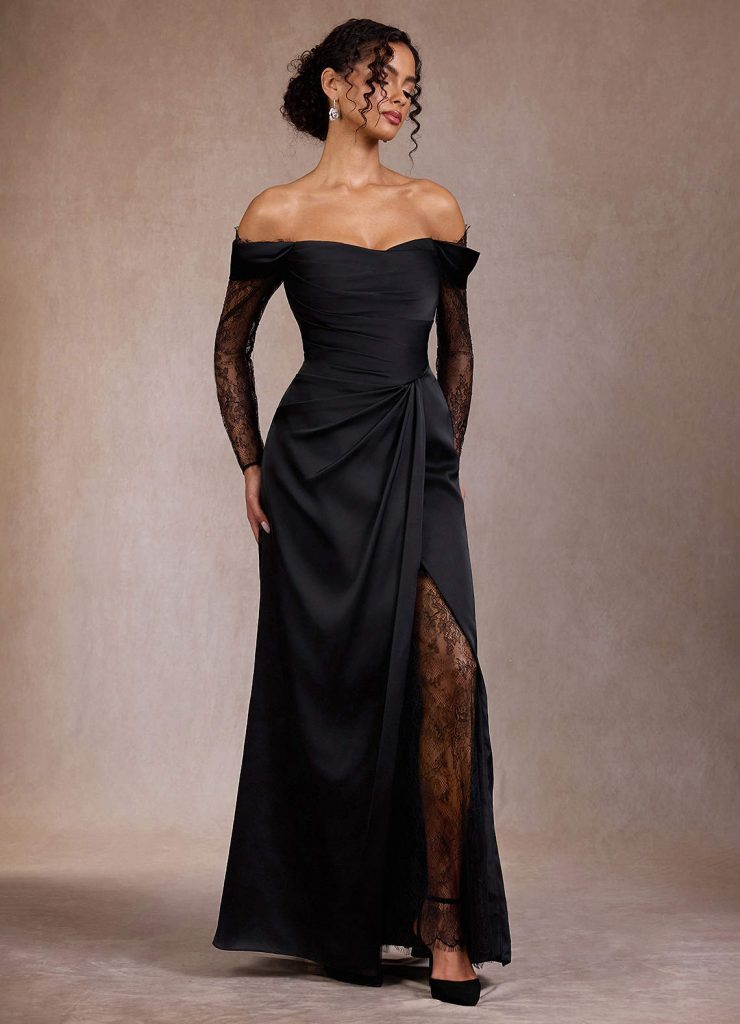
The Grazing Hem — What It Is and Why It Matters
Here’s the thing — ‘floor-length’ doesn’t mean ‘touches the floor.’ The correct hemline on a long formal gown sits approximately half an inch to one inch above the floor while you’re wearing your shoes. It grazes. It doesn’t pool.
A pooling hem collects fabric at the ankle in a way that reads as either too big or too long. The dark color makes it worse — black fabric in a pile at the foot photographs as a heavy weight dragging you down. One inch is the rule. And it’s not a judgment call; it’s geometry.
According to Vogue’s formal attire guide, precise hemline placement is one of the clearest markers of a formal gown that looks intentional rather than off-the-rack and unfinished. The graze is the target.
Why Off-the-Rack Rarely Gets This Right
Standard sizing is designed for an average height with a standard heel assumption — usually around a 3-inch heel on someone approximately 5’6″. If you’re shorter or taller, or wearing different heel heights, the hem will be off. And you won’t know until you put on the shoes.
This is why the tailoring appointment has to happen in the shoes you’ll wear. Not similar shoes. Not shoes with approximately the same heel. The exact pair. The hem is set for that specific shoe and that specific body. There’s no shortcut.
| Hemline Position | How It Reads | Fix |
|---|---|---|
| Grazes the floor (1/2–1 inch clearance) | Intentional, statuesque, polished | Nothing — this is the target |
| Pools on the floor (2+ inches drag) | Heavy, too large, unkempt | Hem up to the graze position |
| Shows ankle clearly (3+ inch clearance) | Reads as cropped or mid-length | Hem down or choose a different length category |
Tailoring Beyond the Hem — Fit at the Waist and Bodice
Loose is the enemy of elegant. Especially in black.
Black fabric doesn’t create the same shadows and depth as a lighter color — it absorbs light evenly across the surface. A loose waist or loose bodice in a dark color just looks baggy; the fabric folds aren’t visible, so the excess reads as flat and unstructured. A well-fitted bodice and defined waist make the black gown look architectural and deliberate.
Because black reads as a flat, monochromatic surface, the fit at the waist and shoulder becomes more visible than it might in a colorful dress. Structure is what replaces the visual interest that color normally provides.
Proportion and Silhouette — Choosing the Right Shape for Your Frame
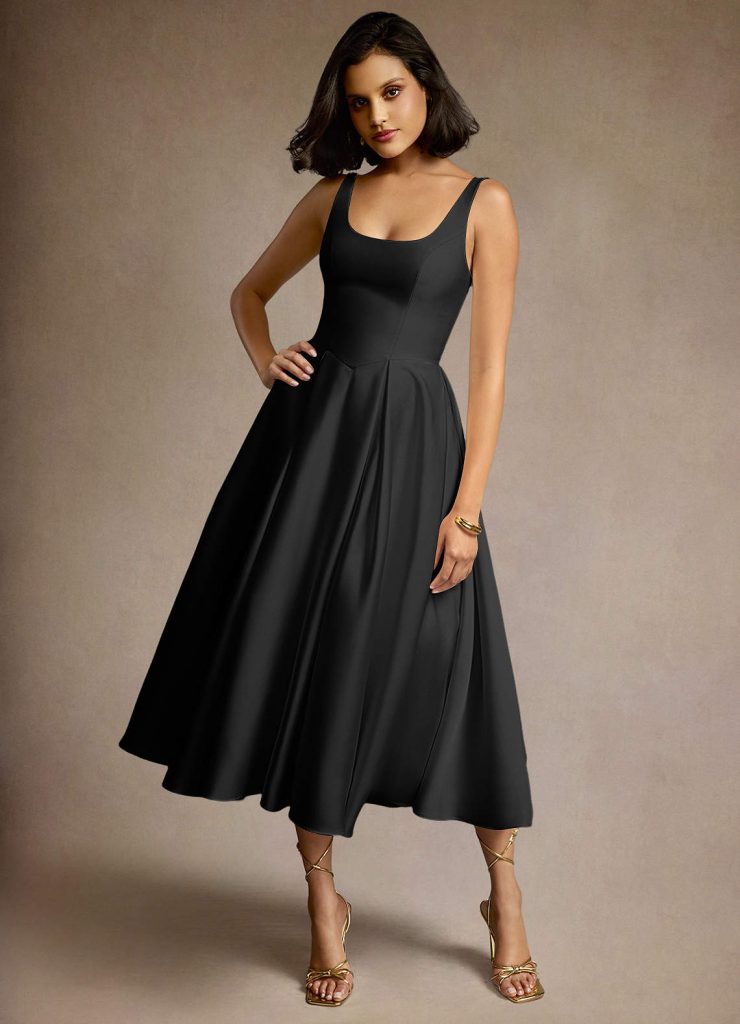
Long black gowns cover more of the body than almost any other formal option. That means the silhouette has to do a lot of work. A poorly chosen black silhouette is more noticeable than the same choice in a color, because the color doesn’t provide visual interest to work with.
A-Line vs. Sheath — The Two Most Reliable Options
An a line formal dress in black does something that colors can’t quite replicate — the flare at the skirt creates movement and dimension that prevents the all-black silhouette from looking flat. I think this is actually one of the most underrated arguments for A-line in black. The fabric catches light at different angles as it fans out, which prevents the ‘block of black’ effect.
A black sheath silhouette is the sleeker, more modern option. It creates the longest vertical line, which photographs very well. But it requires more precise tailoring — a black sheath that’s slightly loose reads as shapeless rather than relaxed.
| Body Type | Best Silhouette | Why | Avoid |
|---|---|---|---|
| Pear-shaped | A-line | Skirt balances hips | Tight sheath below the waist |
| Hourglass | Sheath or fitted column | Follows natural curve | Overly voluminous A-line |
| Athletic/rectangular | A-line or fit-and-flare | Creates a hip and waist illusion | Column with no waist detail |
| Petite | Sleek sheath or A-line | Vertical lines elongate | Heavy ball gown structure |
| Tall | Any — most options work | Height carries all silhouettes | Very short hemlines for formal events |
The Visual Break Problem — and Why You Need One
Here’s something that doesn’t get said enough: an all-black, floor-length gown with no visual break can look like a single continuous dark surface. Not elegant. Just dark.
The visual break comes from the shoe, a neckline detail, a slit, an open back, or accessories. Something that interrupts the monochrome and gives the eye a place to land. Without at least one deliberate visual break, the look reads as heavy rather than sophisticated.
Backless formal dresses in black are a strong, specific example. The covered front maintains formality. The open back provides the visual break. That combination — full coverage from the front, the reveal from the back — is one of the most effective ways to make a long black gown look intentional without adding accessories that compete with the dress.
Fabric Choice — This Changes More Than You’d Think
Why Fabric Is More Visible in Black
Black amplifies texture and fabric quality in both directions. Good-quality black satin has a surface sheen that catches ballroom lighting and looks expensive from across the room. Low-quality synthetic in black looks flat, slightly shiny in the wrong way, and lacks the depth that makes a formal gown read as formal.
A satin formal dress in black is the gold standard for evening events — the surface behavior of quality satin under warm venue lighting is precisely what makes a long black gown look like it cost what it should. Chiffon layers add movement and visual depth. Lace adds texture. Velvet absorbs light and creates a sense of richness. All of them work in black for different reasons.
| Fabric | How It Works in Black | Best Event Context |
|---|---|---|
| Heavy satin | Liquid surface sheen — photographs richly | Evening galas, black-tie events |
| Velvet | Absorbs light — creates depth and shadow | Fall/winter events, indoor evening |
| Chiffon layers | Movement — breaks the flat surface | Any formal event — prevents heavy look |
| Lace overlay | Texture and pattern — visual interest in mono | Weddings, spring/summer events |
| Crepe | Clean matte surface — modern and sleek | Any formal event — most versatile |
Long Sleeve Black Formal Gowns — When They Work Best
Long sleeve formal dresses in black are worth knowing as a specific category. Illusion lace or sheer long sleeves with a black floor-length gown create a look that’s specifically appropriate for conservative venues, religious ceremonies, and cooler-weather formal events — and they can be one of the most photographically striking combinations available. The sleeve adds coverage and detail; the black floor-length silhouette adds formality. The contrast of lace texture against the solid black skirt is the visual break that prevents the ‘block of black’ effect.
Accessories — Where Black Changes the Rules
The Jewelry Rule Inverts for Black
Here’s the thing — with a colorful dress, less jewelry is usually the right call. The color carries the look. With a long black gown, that logic flips. The dress doesn’t provide color contrast. The jewelry does. Without it, the look is all one surface.
That doesn’t mean excessive jewelry. It means intentional jewelry that actually shows up. Drop earrings in gold or silver. A delicate pendant. Something with enough presence to read against the dark fabric. Small stud earrings disappear against a black gown in event photography.
Gold vs. Silver Against Black
Gold is my preference for black formal gowns. Not a rule — but warm gold against black has an Old Hollywood quality that cool silver doesn’t quite match. Silver is cleaner and more modern. Both are appropriate. But if you’re choosing a gala photograph, gold reads warmer and richer under event lighting.
The Clutch and What Not to Do
A small metallic clutch. That’s the call. Gold, silver, or rose gold — nothing too large, nothing too casual. An oversized bag disrupts the vertical line of a floor-length gown. A casual tote is obviously wrong, but I’ve seen it happen. The clutch should be small enough that it doesn’t compete with the hemline or the silhouette.
When Long Black Formal Dresses Work Best — and One Case Where They Don’t
Galas and Black-Tie Events — the Native Environment
A long black formal gown is the most natural fit for black-tie galas, charity events, awards ceremonies, and evening formal weddings. According to Vogue’s guide to formal attire, black floor-length gowns are the consistent benchmark against which other choices are measured at black-tie and formal occasions — they set the formality standard that everything else either matches or falls short of.
Wedding Guest in a Long Black Gown
Fine for most weddings — including daytime weddings at this point. The ‘don’t wear black to a wedding’ guidance is outdated. For a formal dress for wedding guest, a long black floor-length gown with metallic accessories reads as respectful and polished. The one exception: extremely conservative religious ceremonies where the color may be read as mourning in specific cultural contexts. If you don’t know the couple well enough to know their cultural background, check.
Sequined Long Black Gowns — a Specific Case
Sparkly formal dresses in black deserve their own mention. A sequined or heavily embellished long black gown creates visual breaks through the embellishment itself — the individual sequins catch light and create dimension that a flat black fabric doesn’t. This is the one silhouette where the ‘add visual breaks’ rule is built into the dress. The proportion and tailoring rules still apply, but the jewelry and accessory choices can be lighter because the dress surface does that work.
Three Things to Do Before the Event
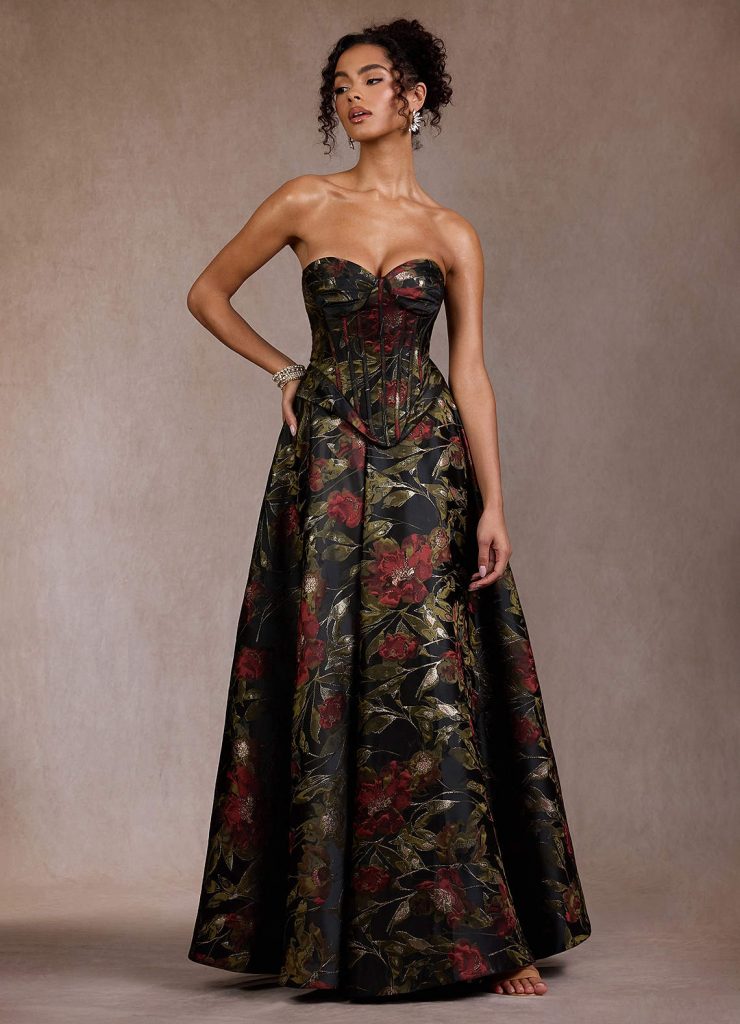
| 1 | Try the dress with the exact shoes you’ll wear — no substitutes. The hemline cannot be tailored correctly without the shoes in place. Not shoes with a similar heel—the actual pair. If the shoes aren’t available at the time of the tailoring appointment, delay the hem until they are. This is the most consistently skipped step and the most consequential one. Getting the hemline set with the wrong shoes means getting it wrong. |
|---|
| 2 | Check the fit at the waist and bodice in the full-length mirror — from across the room. Up close, a slightly loose waist might look fine. From the distance of a gala or reception room, that same looseness reads as the dress not fitting. Step back six feet and check the silhouette. Black fabric doesn’t create the shadow and depth that helps a colorful dress hide imperfect tailoring. The fit has to hold at a distance. |
|---|
| 3 | Identify the visual break before you leave the house. A long black gown with no visual break reads as a dark monochrome surface. The break can be the shoe (metallic or strappy), a neckline detail, earrings, an open back, or a slit. One of those needs to be visible and intentional. Check in a full-length mirror and confirm that something is giving the eye a place to land. If nothing stands out against the black, add one element. |
|---|
Closing Thoughts
The hemline grazes. The shoes are chosen first. The bodice is fitted. And there’s one deliberate visual break — a shoe, a neckline, an earring — that looks somewhere to land. That’s the full checklist for a long black formal gown that looks intentional.
Everything else — the specific silhouette, the fabric, the exact accessory — follows from those four decisions. And it’s genuinely a strong look when they’re all right. The black floor-length gown has staying power for a reason.
Azazie’s collection of long black formal dresses includes satin, chiffon, lace, and crepe options across A-line, sheath, and column silhouettes in sizes 0–30, with made-to-order and custom sizing. Worth browsing once the shoe and tailoring decisions are settled — having the dress in hand first makes those next steps more concrete.
Frequently Asked Questions:
Do long black formal dresses work at every formal event?
Almost. Black floor-length is the native environment for black-tie galas, award ceremonies, formal weddings, and evening fundraisers — it reads as intentional at every one of them. The one case worth thinking about: very conservative religious ceremonies where black carries cultural mourning associations in specific traditions. If you don’t know the couple or hosts well enough to know their background, it’s worth a quick check. Otherwise, black at formal events is the benchmark, not a risk.
What shoes actually work with a long black formal gown?
Pointed-toe heels are the strongest choice — they extend the leg line from the hem downward without interrupting the vertical. Metallic heels (gold or silver) add a visual break at the shoe, which is useful in an all-black look. Block heels work well for long events where stability matters more than maximum elongation. Embellished flats can work for outdoor or summer venues, but the hemline has to be tailored specifically for that heel height — or lack of it. A casual flat does not hold with a floor-length formal gown.
Do I need to get a long black formal dress tailored?
Almost always, yes. Standard sizing is built around a specific height and heel assumption that rarely matches the exact person wearing the dress. The hemline is the critical point — it needs to graze the floor, not pool or hover. That position changes with every quarter-inch of heel height. A tailoring appointment in your actual event shoes, before the event, is the step that makes the dress look like it was made for you rather than borrowed.
What accessories work best with a long black gown?
This is where black changes the usual rule. With a colorful dress, minimal jewelry lets the color do the work. With a black gown, the jewelry has to step up because the dress isn’t providing color contrast. Drop earrings in gold or silver, a small metallic clutch, and that’s usually enough. Small studs disappear against black in event photography. Gold tends to read warmer under event lighting; silver is cleaner and more modern — both are appropriate, but go with something that actually shows up.
What silhouette works best for long black formal dresses?
A-line is the most versatile because the flare creates movement and catches light differently as you walk, which prevents the all-black silhouette from reading as a flat surface. Sheath is the sleeker option — stronger vertical line, photographs very well from the front — but it requires more precise fit because a slightly loose black sheath reads as shapeless rather than relaxed. Mermaid adds drama if the event context calls for it. The one to be careful with: a very voluminous ball gown structure in black can read as heavy rather than dramatic unless the fabric has significant surface interest.
How do I keep a long black gown from looking too heavy or severe?
One deliberate visual break. That’s all it needs. The break can come from a metallic shoe, an open back, a plunging neckline, a slit, or earrings that read from across the room. Without something giving the eye a place to land, an all-black floor-length gown reads as a single continuous dark surface — which is heavy, not sophisticated. You don’t need multiple elements. One thing that interrupts the monochrome and creates contrast is enough.
Does fabric choice matter for long black formal dresses?
More than with any other color. Black amplifies fabric quality in both directions — quality satin in black has a surface sheen under event lighting that looks genuinely expensive; cheap synthetic in black looks flat and slightly wrong. Velvet absorbs light and creates depth and shadow, which is specifically good for fall and winter events. Chiffon layers add movement that prevents the flat surface problem. Lace adds texture and pattern. Crepe is the clean matte option that photographs as modern and sleek. All of them work in black, for different reasons and different events.