
How to Choose Unique Wedding Dresses That Feel True to Your Vision
There’s a wedding I attended in Portland last year — the bride wore a slate-gray velvet column gown. Floor-length, clean silhouette, zero embellishment. The ceremony was in a converted industrial space with exposed brick and Edison bulbs. Every single person in that room knew, without being told, that this was exactly her dress. That’s the thing about genuinely unique wedding dresses. They don’t make people say ‘that’s unusual.’ They make people say ‘of course.’
The distinction matters for shopping. Looking for unusual means filtering for dresses that surprise people. Looking for uniquely yours means filtering for dresses where anyone who knows you would immediately understand the choice. Those two search criteria produce completely different results. Here’s what actually gets you to the second one.
| Before looking at a single dress: describe your wedding in three words that have nothing to do with bridal fashion. The venue, the vibe, the feeling you’re going for. Then describe yourself in three words. If any bride in any context could have chosen the dress you’re considering — if nothing about it is specifically you — it’s probably not the right one. |
|---|
Unusual vs. Uniquely Yours — This Distinction Changes How You Shop
What Unusual Gets You
An unusual dress produces a reaction. People notice it. Some love it immediately, some need a moment. The dress becomes a talking point — which is fine if that’s what you want. Unusual is a legitimate goal.
But unusual dresses are also the ones that can read as costume-y when the venue, the person, and the dress aren’t speaking the same language. The slate-gray velvet gown would have been merely unusual at a conventional ballroom wedding. At a converted industrial space in Portland, worn by someone who wears architectural muted clothing in her actual daily life — it was just right.
What Uniquely Yours Gets You
A dress that reads as a confident specific personal choice rather than a departure from convention for its own sake. It doesn’t have to be unusual at all. A classic ivory A-line can be uniquely yours if every detail — the fabric weight, the sleeve shape, the specific neckline — is what you would have described before looking at anything.
The test I keep coming back to: would someone who knows you well see a photo and immediately think ‘yes, obviously’? That response — ‘obviously’ — is what you’re looking for.
Three Practical Paths to a Dress That Feels Specifically Like You
Color — The Most Underused Route
Honestly, color does more work than almost any other design element and brides consistently underestimate it. A black wedding dress is immediately, unmistakably a personal choice — the silhouette can be completely traditional and the color carries all the distinctiveness. A lavender wedding gown in a classic A-line reads as genuinely personal without any architectural complexity. The color is doing the work that an unusual silhouette would otherwise need to do.
Frustratingly, this is also the route most brides talk themselves out of because of family reactions or perceived tradition. But color is the path with the fewest comfort trade-offs. A dress in an unexpected color still fits, moves, and photographs the same way a white dress would. The only thing that changes is whether it looks like every other wedding dress in every recent photo you’ve seen.
One Unexpected Element on an Otherwise Classic Dress
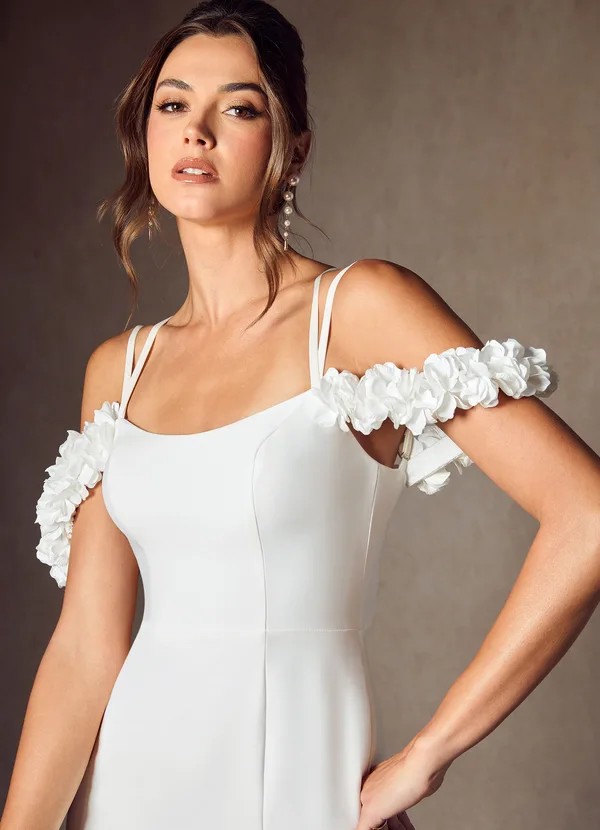
The wedding photos that stop me mid-scroll are almost never the most embellished dresses. They’re simple gowns with one specific thing that’s off-script. A dramatic bow at the back of a plain sheath. A structured petal sleeve on an otherwise minimal A-line. A dramatic train on a dress that has no other drama at all.
The contrast between the classical and the unexpected is what makes a photograph distinctive — not the accumulation of multiple unconventional elements at once. Multiple unexpected elements cancel each other out and start competing for attention. One unexpected element on a clean backdrop reads as specific and intentional. This sounds simple. It’s actually underused.
Short Length — the One Most Brides Don’t Seriously Consider
Floor-length is the default expectation at a wedding. Which means a shorter length is automatically distinctive before any other design choice is made. A short wedding dress in quality fabric photographs with completely different energy than the same silhouette at floor length. And there’s a practical angle that doesn’t get mentioned enough: it’s more comfortable to wear all day. The uniqueness comes from breaking the expectation — at essentially no additional design complexity and with an actual practical benefit.
I’ve watched brides walk into the reception dancing in a knee-length dress and immediately look more like themselves than they did during the ceremony in a floor-length gown. Sometimes the conventional choice requires more performance than the unconventional one.
| Path | Distinctiveness | Comfort Trade-Off | Works Best When |
|---|---|---|---|
| Unexpected color | High — immediately legible | None | Color matches the venue’s aesthetic language |
| One unexpected element | Medium-high | Minimal | Dress is otherwise clean and simple |
| Short length | High — breaks expectation | None — easier to wear | Casual or outdoor venue |
Color Beyond White — What Actually Works in Photos
Dark Colors — Good for a Counterintuitive Reason
A black wedding dress photographs with extraordinary contrast — everything around it (flowers, venue, guests) reads more vividly because the dress isn’t competing with any of it. Black bridal is, and I realize this sounds counterintuitive, one of the cleanest-looking options in wedding photos because it simply holds the space. Everything else in the frame gets to be itself.
The social conversation around black wedding dresses has shifted significantly in the last five years. At a contemporary venue, an evening wedding, or any setting where the couple has an editorial or architectural aesthetic — black reads as correct rather than provocative.
Soft Non-White Colors — More Effective Than Expected
A light grey wedding dress option, or a soft off-pink in an A-line, are often more effective at feeling ‘unique’ than brides expect. They’re not dramatically non-traditional — they don’t require an explanation at a more conservative wedding. But they read clearly as personal choices rather than defaults.
Wait — I want to be specific about the off-pink category. A blush that reads almost-white in certain lighting is different from a deliberate dusty rose. The former can read as a near-miss at conventional bridal. The latter reads as an intentional choice. Make sure the color is saturated enough to read as a choice.
Champagne and Warm Neutrals
A boho champagne wedding dress in a relaxed silhouette is one of the most consistently well-received ‘unique’ bridal choices. It reads as distinctly personal without requiring justification to family. The warmth of champagne with a boho silhouette photographs especially well in natural light — there’s an organic quality to warm neutrals in outdoor settings that cold whites don’t have.
Before You Buy: Three Steps Worth Doing First
| 1 | Identify the one personal element — before looking at dresses. The mistake most brides make is starting with the dresses and trying to find one that feels personal. Start instead with the personal element: unexpected color, shorter length, a specific sleeve style, a neckline you’ve always wanted to wear. One element. Then look for dresses that feature that element. The uniqueness comes from the specific feature you’ve chosen, not from searching for overall uniqueness in general. |
|---|
| 2 | See the dress in your own lighting — not just boutique lighting. Boutique lighting is designed to flatter. A unique dress — particularly one in an unexpected color or with distinctive surface texture — can look completely different in natural daylight. Azazie’s at-home try-on (available for wedding dresses) lets you see how the color and fabric read in your own home, which is a more reliable test than any showroom. This matters more for distinctive choices than for classic ivory gowns, because the choice draws attention to the fabric and color. |
|---|
| 3 | Apply the same comfort tests as any wedding dress. A unique dress shouldn’t require comfort trade-offs that a conventional dress wouldn’t. If the distinctive element is an architectural sleeve, test whether you can raise your arms to hug people. If it’s a dramatic train, test walking on the actual surface of your venue before the wedding day. The distinctiveness of the choice doesn’t justify wearing something you’ll be uncomfortable in for eight hours. |
|---|
Fabrics That Create Distinctive Looks — and How They Wear
| Fabric | Unique Quality | Best Use |
|---|---|---|
| Velvet in color | Rich, distinctive — especially non-white | Fall/winter; dramatic interiors; evening ceremonies |
| Crepe in unexpected color | Modern, architectural — matte lets color read fully | Any silhouette; all seasons; color as the statement |
| Printed fabric | Immediately distinctive — no one else has it | Destination, outdoor, garden; botanical venues |
| Lace in non-white color | Unexpected and textural together | Romantic outdoor settings; garden ceremonies |
| 3D floral applique | High visual interest on the surface | Garden, botanical venue; where nature is the setting |
Closing Thoughts
I asked the Portland bride about the dress after the reception. She said she’d tried on about forty dresses — ivory ballgowns, lace A-lines, everything conventional and beautiful and wrong. She found the gray velvet at a small sample sale in Brooklyn, put it on, texted her partner a photo from the dressing room. His response: one word. ‘Obviously.’
That’s the test. If the answer is ‘obviously’ — the dress is unique in the way that actually matters. Azazie’s wedding dress collection includes over 200 styles in sizes 0 to 30, covering unexpected colors, non-traditional silhouettes, and distinctive details — with made-to-order and custom sizing available.
Frequently Asked Questions
What actually makes a wedding dress unique?
Not the number of design elements — actually the opposite. A dress reads as unique when it reads as a specific personal choice rather than a default. That can come from color, an unexpected length, a single distinctive detail, or a fabric no one else in your wedding circle would choose. The question isn’t ‘is this unusual?’ It’s ‘would someone who knows me see this and immediately think of me?’
Can I look elegant in a unique wedding dress?
Yes — elegance comes from fit and proportion, not from conventional choices. A well-fitted black wedding dress in quality crepe is deeply elegant. So is a cream-colored option with an unexpected sleeve shape. The uniqueness is in the specific choice. The elegance comes from the quality of the execution.
What silhouettes work best for unique wedding dresses?
Classic silhouettes — A-line, sheath, fit-and-flare — are actually more effective as a base for a unique dress than highly architectural ones. A classic A-line in an unexpected color, or with one distinctive element, photographs more powerfully than a complicated silhouette trying to do too much at once. The classic base lets the unique element stand out clearly.
What fabrics work best for unique wedding dresses?
Quality crepe in any color. Velvet for fall and winter. Printed fabrics for destination or outdoor settings. Lace in unexpected colors for romantic-but-distinctive looks. Quality matters more for distinctive choices than for conventional ones — because a unique dress draws attention to the fabric itself.
Are unique wedding dresses available in plus sizes?
Yes. Azazie’s collection includes over 200 wedding dresses in sizes 0 to 30 with made-to-order construction and custom sizing. The same color and design options — including non-white and distinctive silhouettes — are available across the full size range. Custom sizing is especially valuable for distinctive styles where the fit needs to support the specific design.
What’s the biggest mistake brides make when shopping for a unique dress?
Looking for the most distinctive dress rather than the most personally authentic one. Those aren’t the same. A dress that’s unusual for its own sake can read as a costume. A dress that happens to be unusual because it’s specifically right for you reads as confident and personal. The question isn’t ‘will people notice this?’ It’s ‘does this actually feel like me?’