
What Should I Look for When Trying On Wedding Dresses?
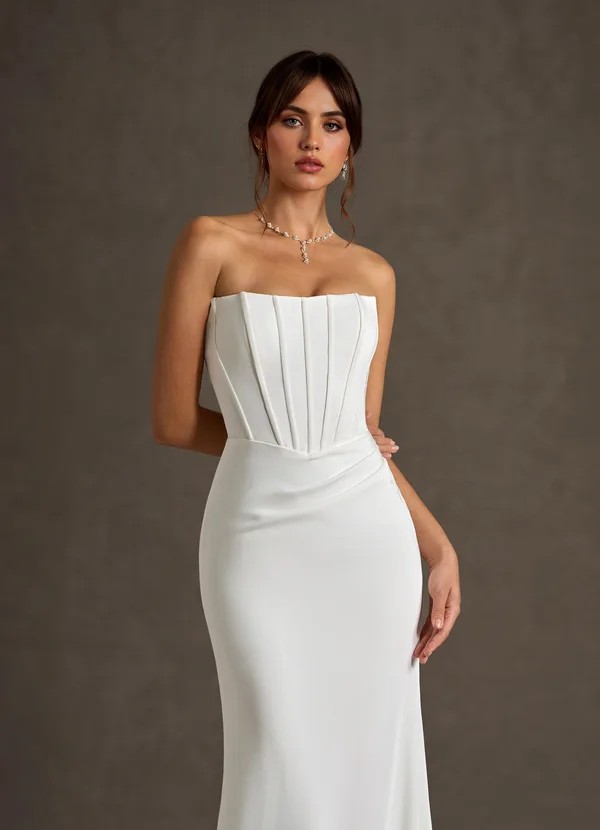
The try-on is where dreams meet reality—in the best way.Go in with a simple plan and you’ll leave with clarity, not confusion.Below is a calm, step-by-step guide to exactly what to look for when trying on wedding dresses.You’ll get short checklists, practical tests, and easy tables so you can evaluate each gown quickly and fairly.
Bring your final-height shoes, skin-tone seamless undergarments, and a tie-back or clip for hair.For each dress, do five tests: breath, mobility (sit, stairs, hug), lighting (daylight + warm light), support (no slipping), and photo (front/side/back).
Check fabric behavior (wrinkles, cling), bustle plan, and hem length for your venue surface.Pick one focal detail (veil or sleeves or bow), and leave room for 2–3 fittings over 6–10 weeks.
The Try-On Strategy (3 decisions that solve 80%)
- Silhouette first.
Shortlist two silhouettes that already feel good on your body. - Neckline & support second.
Match the frame to your shoulders, bust needs, and venue formality. - Fabric last.
Choose the texture/weight that behaves in your light and climate.
Once those three align, details become easy, not overwhelming.
What to Bring (and Why)
- Shoes with final heel height.
Hem and posture tests rely on exact height. - Skin-tone seamless panties (bonded edge).
Keeps lines invisible under crepe or satin. - Your likely bra/cups or longline/bodysuit.
Support changes neckline stability. - Hair tie/clip + light makeup.
Neckline and veil balance show better with hair up. - Camera phone + one trusted friend.
Short videos are more honest than mirrors. - A list of 3 non-negotiables.
Example: sleeves, easy bustle, chapel veil.
The 10-Point Dress Test (do this for every gown)
- Breath test: inhale deeply; can you breathe without bracing.
- Sit test: sit on a chair, then stand—no digging, no strain.
- Stairs test: a few steps up/down; confirm stride length and train control.
- Hug test: arms around someone—check sleeve/armhole comfort.
- Reach test: lift arms overhead—no popping straps or shifting bodice.
- Walk test: 10 big steps; does the skirt catch or twist.
- Spin test: slow turn; watch how fabric drapes and re-settles.
- Photo test: 10-sec video in daylight and warm indoor light (front/side/back).
- Hem test: does the front just “kiss” the ground in your shoes.
- Bustle preview: how will the train lift; can a friend do it fast.
If a dress fails two or more of these, move on with no guilt.
Fit Signals (green = keep, yellow = alter, red = pass)
| Area | Green (Great) | Yellow (Fixable in Alterations) | Red (Pass) |
| Bodice | Flat, secure, no gaping | Minor dart/cup swap; micro-elastic | Slides down; deep gaping |
| Straps/Sleeves | Stay put; full arm reach | Shorten/add elastic tunnel | Cut circulation; pop when raised |
| Waist/Hips | Smooth; breathing easy | Small nip/taper | Can’t sit comfortably |
| Hem | Front just grazing floor | Shorten; add horsehair at edge | Tripping; front puddling |
| Train/Bustle | Clear plan; easy demo | Add points; move attachment | No feasible bustle |
| Fabric Behavior | Doesn’t cling or wrinkle fast | Half slip/lining tweak | Shows every line; snags |
| Back/Closure | Smooth zip; buttons align | Add modesty panel | Strain marks; zipper warping |
Silhouette Cheat Sheet (how to judge quickly)
| Silhouette | Keep it if… | Watch out for… | Fast comfort tweak |
| A-line | You feel light; waist looks defined | Too many layers in heat | Airy lining; small slit |
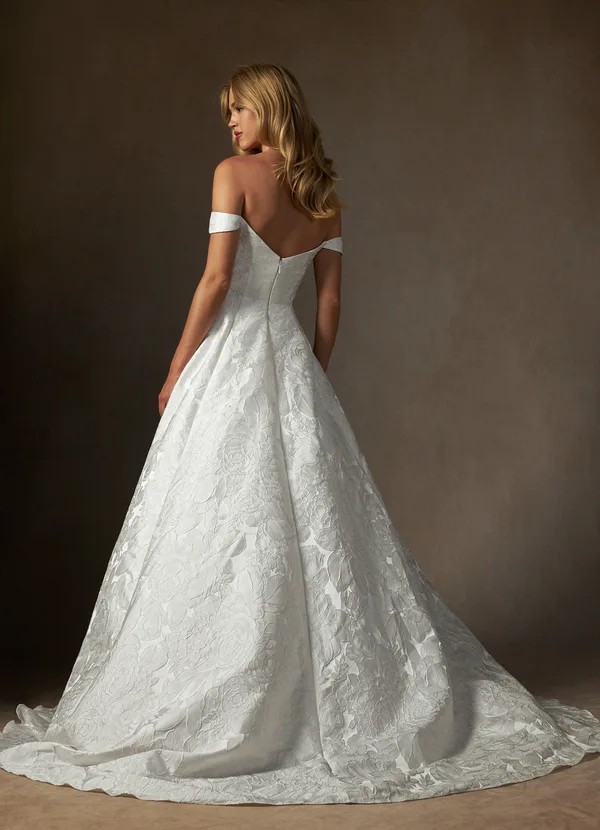
| Ball gown | Skirt moves, not drags | Doorways, stairs, weight | Engineered bustle; gloves for hold |
| Mermaid/Fit-and-Flare | You can sit and walk easily | Knee too tight; hem catches | Raise flare; add slit |
| Sheath/Column | Lines are smooth in video | Panty seams, cling | Bonded brief; half slip |
| Empire | Breath feels free | Too sheer in light | Add lining; cups matched to mesh |
| Tea-length/Mini | Steps feel natural | Over-short hem on stairs | Add under-tulle or adjust hem |
Neckline & Support Matrix (match the frame to the body)
| Goal | Necklines to try | Support that disappears |
| Open the face & elongate | V, soft scoop | U-plunge bodysuit or plunge bra |
| Structured modern | Square, bateau | Balconette or longline |
| Romantic portrait | Off-shoulder, sweetheart | Longline with sewn-in cups |
| Modest/regal | Bateau, high neck + back detail | Inner corsetry / cups |
| Editorial | One-shoulder, deep V + illusion | Cups + tape map |
Tip: For off-shoulder, ask for a hidden elastic tunnel so arms move freely.
Fabric Behavior Guide (feel + photos)
| Fabric | Looks like | Feels like | Try-on checks |
| Satin/Mikado | Smooth glow; formal | Structured; warmer | Glare in noon light? Steam marks? |
| Crepe | Matte, tailored | Comfortable stretch | Lines under bright light? |
| Chiffon/Georgette | Airy, flowy | Cool and light | Sheerness in window light? |
| Tulle/Organza | Buoyant volume | Light layers | Snags; static—use antistatic spray |
| Lace (over base) | Textured depth | Depends on base | Motif placement; mesh tone match |
| Charmeuse | Liquid shine | Slippery | Every ridge shows; needs slip |
Venue & Weather Logic (dress choices that fit the space)
| Setting | Priority | What to check in try-on |
| Cathedral/Ballroom | Scale + formality | Train length, button alignment, veil balance |
| Garden/Vineyard | Movement + texture | Hem “kisses” grass; antistatic lining |
| Beach/Coastal | Breathability + wind | Plain-cut fingertip veil; sweep train |
| Rooftop/Loft | Clean lines + wind control | Veil pins; elevator/doorway clearance |
| Museum/Hotel | Architectural polish | Minimal sparkle glare; quiet hem |
| Barn/Winery | Practical bustle + romance | Board gaps; gravel; block heels |
Two-Visit Plan (so you don’t overwhelm yourself)
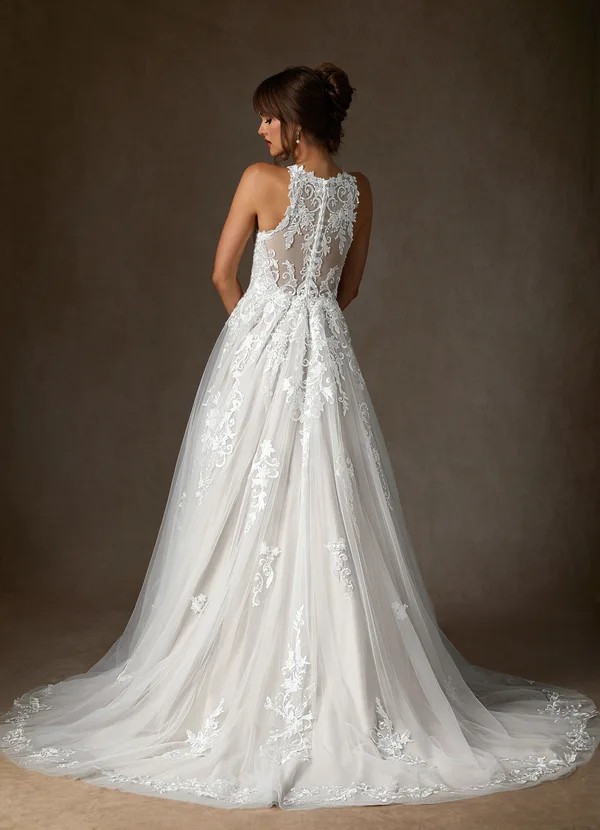
Visit 1 — Shape & comfort
- Try two silhouettes (e.g., A-line + mermaid) and three necklines (square, off-shoulder, soft V).
- Film quick spins in daylight + warm light.
Visit 2 — Details & decision
- Re-try your top two gowns in the right size range.
- Bring veil options; test bustle; walk stairs; sit for 2–3 minutes.
Choose the one that needs the fewest tricks to look perfect.
That’s your dress.
Red Flags (politely pass on these)
- You cannot take a full breath.
- You cannot sit without bracing your hands.
- The bodice slides when you lift your arms.
- The hem puddles in front with your actual shoes.
- The bustle has no clear solution.
- The fabric shows every seam even with a bonded brief.
- You hate how it looks in video, even if the mirror was kind.
Green Lights (strong “yes” signals)
- You forget you’re wearing it while moving.
- Your shoulders relax and posture improves.
- The back view is as good as the front.
- Simple fixes solve small issues (cup swap, micro-dart, hidden elastic).
- Your trusted friend says, “This looks like you.”
Accessory Logic (keep one focal point)
- Cathedral veil pairs best with clean bodices or classic lace.
- Statement sleeves want a plain veil and minimal jewelry.
- Sculptural bow works in mikado/satin with simple earrings
- 3D florals shine under light tulle; skip heavy beading nearby.
Pick one hero element; let everything else support it.
Shoes, Hem & Bustle (tiny choices, big comfort)
- Shoes: choose height before pinning; consider block/wedge for lawn.
- Hem: front should graze the floor—no puddle, no toe-peek in still stance.
- Bustle: practice twice; record a helper video; label points with thread colors.
Day-Of Comfort Kit (pack now, relax later)
- Fashion tape + spare nipple covers.
- Anti-chafe balm + small deodorant wipes.
- Mini sewing kit + safety pins + clear elastic.
- Lint roller + microfiber cloth for makeup dabs.
- Heel pads/nonslip stickers + clear heel protectors for lawn.
Size Choice & Alterations (how to think about fit)
- Order to your largest measurement (bust/waist/hips).
- Plan 2–3 fittings over 6–10 weeks; finish 2–4 weeks before the wedding.
- Bring the same shoes and undergarments to every fitting.
- Lock sleeves/neckline/train choices before the first pin.
Undergarments That Disappear (fast pairing table)
| Dress challenge | Underlayer that works |
| Crepe shows lines | Bonded-edge thong/brief + thin half slip |
| Deep V | U-plunge bodysuit or sewn-in cups + tape map |
| Off-shoulder | Longline strapless + hidden elastic tunnel |
| Low back | Low-back longline or cups + tape |
| Illusion mesh | Cups matched to mesh tone (test in daylight) |
Questions to Ask Your Stylist (and why)
- “How will this bustle be engineered?” → clarity = calm later.
- “Can we raise the flare/adjust the slit for better stride?” → movement solves comfort.
- “What’s your plan for cup support or darts here?” → neckline security.
- “How many layers can we remove for heat?” → weight control for summer.
- “What’s the steaming and transport plan?” → wrinkle control on the day.
Real-World Scenarios (copy what fits you)
- A) Cathedral Evening, formal
- Try mikado ball gown and crepe fit-and-flare with off-shoulder or square neck.
- Check cathedral veil weight, button alignment, and aisle stride.
- B) Garden Afternoon, breezy
- Try chiffon/georgette A-line and soft empire with V or scoop.
- Hem “kisses” grass; fingertip or chapel veil; antistatic lining.
- C) Museum/Loft, modern
- Try crepe column or structured A-line with square/bateau neck.
- Plain-cut veil; wind pins; check glare under spotlights.
- D) Beach Destination, hot
- Try georgette sheath or light A-line with spaghetti/halter.
- Plain fingertip veil; sweep train; breathable lining.
Troubleshooting (common try-on issues)
- Straps slip: move placement in 0.5–1 cm; add discreet gripper/elastic.
- Bodice gapes: add micro-dart or swap cups; tape only as backup.
- Mermaid too tight at knees: raise flare point; add slit/godet.
- Veil snags on buttons: choose covered buttons or veil on after buttoning.
- Static cling: antistatic spray on lining; moisturizing sheets in garment bag.
- Satin glare outdoors: schedule photos in softer light; add matte veil/topper.
Photo Logic (how to decide between two favorites)
- Film front/side/back in window light and in warm boutique light.
- Zoom to 50–70% on your face and neckline—where do your eyes look the brightest.
- If one dress needs tape, clips, and constant adjusting, pick the other.
- Ask: Which looks like me, moving naturally—not “posed me.”
Do / Don’t (keep it simple)
Do
- Keep an open mind on fabrics and necklines.
- Commit to one focal detail (veil, sleeves, or bow).
- Test stairs, sit, and a proper hug every time.
Don’t
- Change shoes/undergarments between fittings.
- Buy for the body you might have later.
- Ignore the back view—it’s in half your photos.
Timeline You Can Trust
- Order window: made-to-order 8–10 months; custom/semi-custom 10–12 months; in-stock 4–6 months.
- Fittings: 2–3 sessions over 6–10 weeks; finish 2–4 weeks before the wedding.
- Lock choices: shoes, undergarments, sleeves/veil/train before first pin.
Final Takeaway
A perfect try-on is about movement, breath, and lightChoose the silhouette that already feels good, the neckline that frames you, and the fabric that behaves in your venue’s lighting and climate.
Use the 10-point dress test, the fit signals table, and the two-visit plan to keep decisions calm and clear.Then commit to one focal detail, plan 2–3 fittings, and practice your bustle.
When a dress lets you breathe, move, and smile without thinking—that’s the one.
Everything else is just good tailoring.