
What Is the Best Wedding Dress for a Winter Wedding?
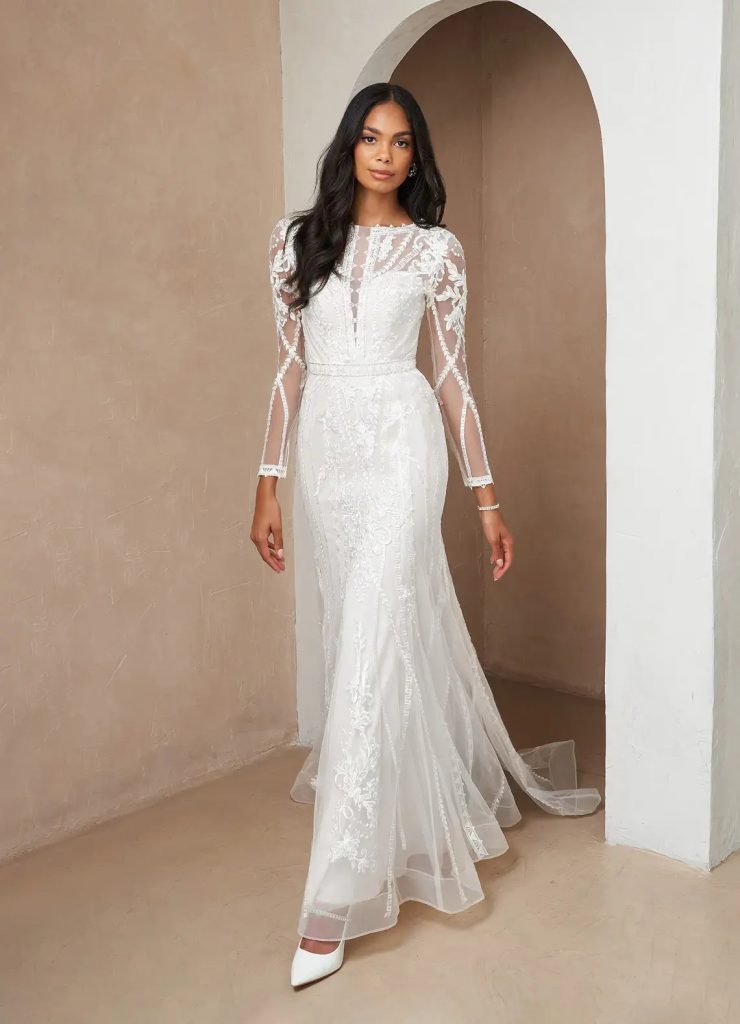
Winter weddings call for elegance with warmth and structure. Your gown should look regal in low light and keep you comfortable from ceremony to portraits. The sweet spot is formal silhouettes, substantial fabrics, and smart layering that still feel light in motion.
Use this guide to choose a silhouette, fabric, sleeves, train, and accessories that love cold weather—and photograph beautifully.
For a winter wedding, choose structured fabrics like satin, mikado, velvet, or heavy crepe with long sleeves or an illusion sleeve.Top silhouettes: ball gown or structured A-line for grand spaces, and fit-and-flare in crepe or satin for modern formality.
Add a chapel or cathedral train and a cathedral veil for scale.Finish with a cape, bolero, or coat, covered buttons, and gloves.Plan 2–3 fittings over 6–10 weeks, and keep a 2–4 week buffer for steaming and winter travel.
Winter Wedding Dress Map: Three Big Decisions
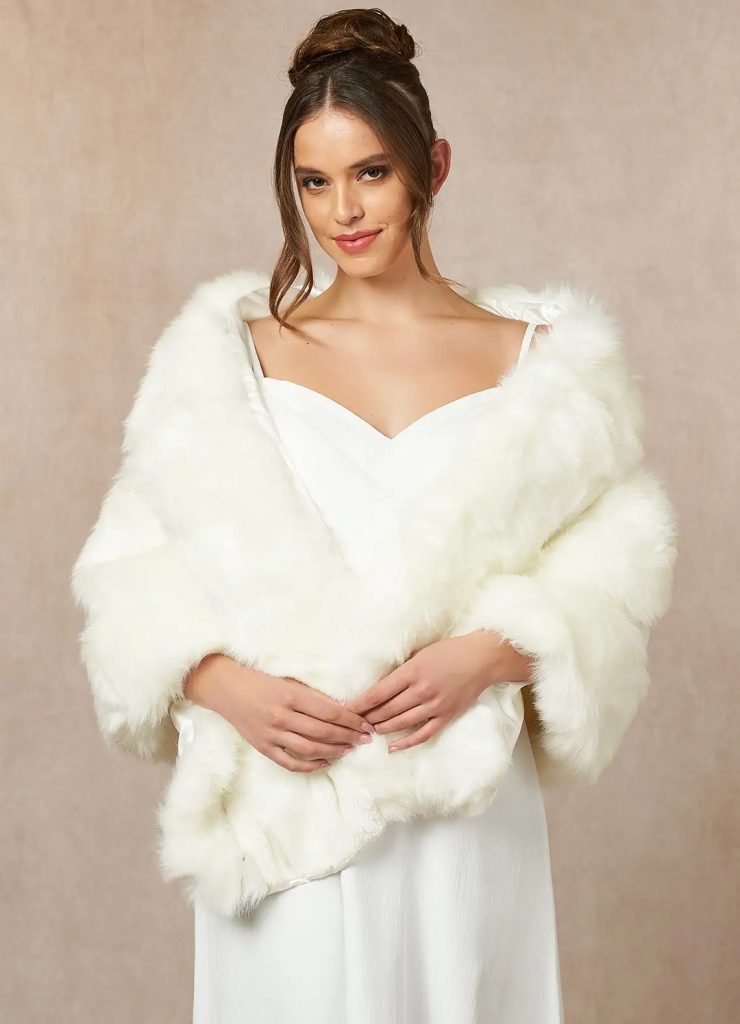
- Fabric with presence.
Choose materials that hold shape and retain warmth without feeling heavy. - Silhouette that matches your venue’s scale.
High ceilings and long aisles love big skirts and long veils. - Layering that looks intentional.
Capes, coats, or boleros should feel designed-in, not thrown on.
Winter Fabrics at a Glance (Warmth, Structure, and Shine)
| Fabric | Warmth | Structure | Shine/Finish | Why It’s Great for Winter |
| Mikado | Medium–High | High | Low–Soft sheen | Crisp architecture for ball gowns and bows |
| Satin (heavier weight) | Medium | Medium–High | Luminous | Regal glow in candlelight and evening venues |
| Heavy Crepe | Medium | Medium | Matte | Modern, tailored lines with quiet luxury |
| Velvet | High | Medium | Plush sheen | Luxe warmth; perfect for sleeves, toppers, or the whole gown |
| Organza (over base) | Low–Medium | Medium | Subtle | Adds floating volume without summer weight |
| Lace over satin/crepe | Medium | Medium | Matte–Soft | Heirloom texture; ideal for illusion sleeves and bodice |
Winter rule of thumb.
Use a structured base (satin/mikado/crepe) and layer lace, organza, or tulle thoughtfully for texture and movement.
Best Winter Silhouettes (What Works and Why)
| Silhouette | Why It’s Winter-Ready | Style Notes |
| Ball Gown | Holds warmth with volume; makes an entrance in grand spaces | Mikado or satin; off-the-shoulder + long sleeves = formal magic |
| Structured A-Line | Universal flattery with clean movement | Crepe or satin base; cathedral veil for scale |
| Fit-and-Flare / Mermaid | Elegant, sculpted lines that flatter curves | Heavy crepe or satin; add cape or bolero for warmth |
| Column / Sheath (heavy crepe) | Architectural minimalism for modern venues | Pair with a tailored coat, cape, or gloves |
| Empire (refined) | Gentle drape over warm base fabrics | Long sleeves and a chapel veil keep it formal |
Necklines, Sleeves, and Backs That Read “Winter Formal”
Necklines
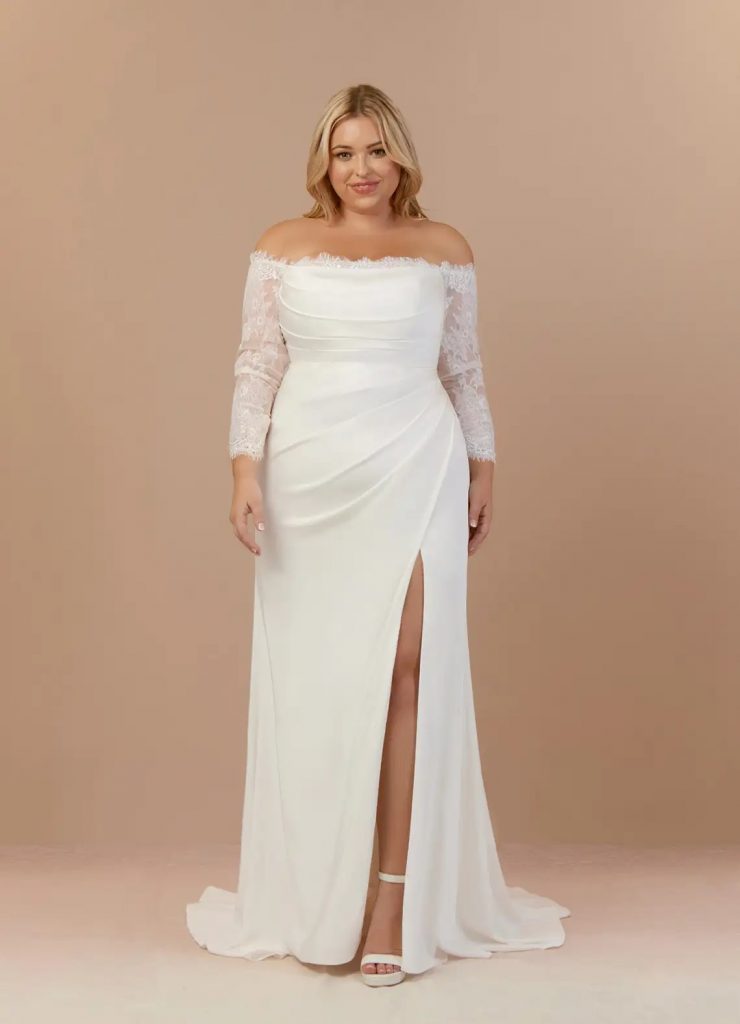
- Off-the-shoulder: frames the collarbone; pairs well with gloves and long veils.
- Square: crisp, modern, and supportive with long sleeves.
- Bateau / High Illusion: modest and regal; perfect with lace or button detailing.
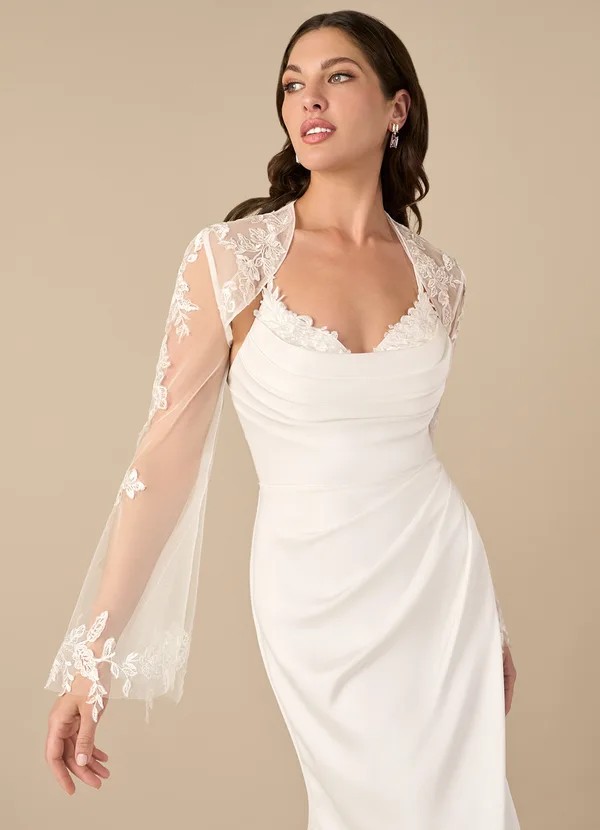
- Sweetheart (structured): classic contour; add fitted or illusion sleeves for warmth.
Sleeves
- Fitted long sleeves in crepe, satin, or lace keep the line elegant.
- Illusion sleeves deliver coverage without weight.
- Detachable sleeves give ceremony drama and reception freedom.
- Juliet sleeves add vintage winter romance without bulk.
Back details
- Covered buttons from nape to hem feel couture and seasonal.
- Bow or tails at the back waist works best in mikado or satin.
Trains and Veils: Scale for Winter Spaces
| Element | Good | Better | Best |
| Train | Sweep | Chapel | Cathedral |
| Veil | Fingertip | Chapel | Cathedral (plain or lace edge) |
| Bustle | Simple | Custom points | Engineered bustle for weighty skirts |
Guideline.
Evening ceremonies, cathedrals, estates, and historic hotels adore a cathedral veil plus a chapel/cathedral train.
Choose an engineered bustle so your evening remains effortless.
Winter Layering: Capes, Coats, Boleros, and Gloves
Toppers that look designed-in
- Cape or capelet in satin, crepe, or organza: ceremonial drama, instantly warm.
- Tailored coat in crepe or wool-blend lining: modern, editorial edge.
- Bolero or shrug with lace or fur-effect (faux) texture: soft, romantic coverage.
- Gloves: wrist-length for subtlety; opera-length for maximal formal impact.
How to coordinate
- Match topper fabric weight and sheen to your gown.
- Keep closures minimal and hidden so lines stay clean.
- Bring toppers to every fitting to calibrate arm mobility and veil placement.
Warmth Without Bulk: Inside Engineering That Matters
- Lining choices: choose smooth, breathable linings that insulate without overheating indoors.
- Boning & support: enough structure for posture, not so much that it creates cold “pressure points.”
- Horsehair hem: use where needed to hold shape, not as a heavy layer end-to-end.
- Illusion tulle color match: deep winter lighting emphasizes mismatches—color-match mesh to skin tone.
Venue & Season Matrix (Winter Edition)
| Venue / Time | Best Gown Personality | Veil & Train | Notes |
| Cathedral (evening) | Mikado ball gown; off-shoulder with long sleeves | Cathedral veil; cathedral train | Candlelight loves satin/mikado |
| Historic estate / ballroom | Structured A-line or fit-and-flare in satin/crepe | Chapel or cathedral veil | Add gloves and covered buttons |
| Luxury hotel / museum | Heavy crepe column with bateau neck | Chapel veil | Editorial minimalism reads formal |
| Mountain lodge | Velvet sleeves or velvet topper + crepe/satin gown | Chapel veil; sweep train | Warm layers; consider boot-friendly hem |
| City hall → winter rooftop | Crepe sheath with square neck | Fingertip veil or none | Tailored coat or cape for outdoor photos |
Color & Texture in Winter Light
- Ivory and diamond white glow in cool light; champagne liners add depth under lace.
- Mikado and satin create a regal sheen at dusk and indoors.
- Beaded lace catches candlelight—keep it refined to avoid visual “noise.”
- Velvet accents photograph luxuriously in low light and snow.
Quick-Pick Matrix (Your Priorities → Best Winter Moves)
| Your Priority | Fabrics | Silhouette | Add-Ons |
| Maximum formality | Mikado / satin | Ball gown or A-line | Cathedral veil, covered buttons |
| Modern minimal | Heavy crepe | Column or fit-and-flare | Bateau neck, gloves, chapel veil |
| Warmth + romance | Satin + lace overlay | A-line | Illusion sleeves, lace-edged veil |
| Two looks in one | Satin/crepe base | Fit-and-flare or column | Detachable sleeves or overskirt |
| Outdoor portraits | Crepe + velvet topper | Any structured base | Cape/coat; hand-warmers off camera |
Neckline & Sleeve Pairing Table (Fail-Safe Winter Combos)
| Neckline | Sleeve Options | Why It Works |
| Off-shoulder | Fitted long sleeve; detachable puff | Frames collarbone; balances big skirts |
| Square | Fitted sleeve; gloves | Architectural clarity; supports jewelry |
| Bateau / High Illusion | Illusion or fitted sleeves | Regal, modest, and photogenic |
| Sweetheart (structured) | Illusion lace sleeve | Warmth with softness; heirloom feel |
Alterations Timeline (Winter-Smart)
Plan 2–3 fittings over 6–10 weeks, finishing 2–4 weeks before the wedding.
Factor in weather delays for travel and steaming.
| Fitting | When | Bring | Focus |
| First | 8–10 weeks prior | Final heels, undergarments, topper/veil | Global fit; hem & train math; sleeve mobility |
| Second | 4–6 weeks prior | Same items; gloves | Bustle engineering; button alignment; topper closure |
| Final | 1–2 weeks prior | Full look | Comfort in movement; steam plan; transport steps |
Tips
- Lock heel height early—winter surfaces (stone, carpet) change stride.
- If adding sleeves or a cape, bring them to every fitting.
Winter Care, Steaming & Transport
- Steam in sections (bodice → sleeves → skirt → train) to avoid condensation marks in cold air.
- Keep your dress in a breathable garment bag; avoid plastic that traps moisture.
- Transport across the back seat or hang high; bring a clean blanket to protect fabric from car interiors.
- At snowy entries, assign someone to ground-spot the hem and train.
Accessories That Elevate (Without Weight)
- Veils: cathedral for ceremony; consider switching to fingertip for reception.
- Gloves: wrist-length for subtle polish; opera-length for grand formality.
- Headpieces: structured headbands, combs, or pearl pins that won’t snag in toppers.
- Belts/bows: one focal accent only; mikado and satin hold sculptural bows best.
Troubleshooting (Cold-Weather Edition)
- “I’m cold between photos.”
Add a cape/coat that fastens cleanly; use hand warmers hidden inside muff or gloves. - “My satin shows every pull.”
Confirm smoothing undergarments and seam ease; stand naturally during portraits. - “Off-shoulder lifts when I raise my arms.”
Ask for hidden elastic or a micro-gusset; test hugs and reaching. - “Train gets wet on snow.”
Use a clear bustle for outdoor portraits; assign a helper to carry the hem between shots. - “Buttons snag my veil.”
Choose covered buttons with smooth edges or put the veil on after the dress is fully closed.
Try-On Scenarios (Use These to Decide Fast)
Scenario A — Cathedral, evening
- Pick: Mikado ball gown, off-shoulder with fitted sleeves.
- Style: Cathedral veil, covered buttons, pearl studs, gloves.
Scenario B — Ballroom with grand staircase
- Pick: Satin A-line with illusion lace sleeves.
- Style: Chapel veil with lace edge, sleek bun, statement earrings.
Scenario C — Museum hotel, modern formal
- Pick: Heavy crepe column with bateau neckline.
- Style: Chapel veil, opera gloves, button back, headband.
Scenario D — Estate garden (winter dusk)
- Pick: Fit-and-flare in crepe or satin with square neckline.
- Style: Detachable sleeves for ceremony; cape for portraits; fingertip veil at reception.
Print-Friendly Comparison Tables
A) Silhouette × Fabric × Formality
| Silhouette | Best Winter Fabric | Formality | Notes |
| Ball Gown | Mikado / Satin | High | Bows, buttons, cathedral veil |
| A-Line | Satin / Crepe | High | Lace overlays or clean seaming |
| Fit-and-Flare | Crepe / Satin | High | Chapel/cathedral train; gloves optional |
| Column | Heavy Crepe | High (minimal) | Bateau/square neckline; coat or cape |
B) Layering & Accessory Matrix
| Add-On | Fabric | Purpose | Pair With |
| Cape/Capelet | Crepe/Satin/Organza | Instant warmth & drama | Ball gown, A-line, column |
| Bolero/Shrug | Lace/Velvet-effect | Romantic coverage | Lace gowns; winter portraits |
| Gloves | Satin/Crepe | Classic formality | Off-shoulder, square, bateau |
| Bow/Streamers | Mikado/Satin | Couture focal point | Clean bodice; button back |
C) Veil & Train Scale by Venue
| Venue | Veil | Train |
| Cathedral | Cathedral | Cathedral |
| Estate/Ballroom | Chapel/Cathedral | Chapel/Cathedral |
| Museum/Hotel | Chapel | Chapel |
| City Hall → Reception | Fingertip/None | Sweep/Chapel |
Decision Framework (5 Steps to Your Winter Shortlist)
- Pick your silhouette: ball gown for scale, structured A-line for ease, fit-and-flare or column for modern polish.
- Choose your base fabric: mikado/satin for glow; heavy crepe for matte elegance; add lace for texture.
- Add warmth elegantly: fitted/illusion sleeves; cape, bolero, or tailored coat.
- Scale veil & train to the venue: chapel or cathedral, with an engineered bustle.
- Lock the timeline: 2–3 fittings; shoes and undergarments set; 2–4 weeks of buffer for winter logistics.
Sample Winter Timelines (Copy & Adapt)
Mikado Ball Gown + Long Sleeves
- Order: 9–11 months out.
- Fittings: 10 weeks, 6 weeks, 2 weeks; bring veil and gloves.
- Focus: sleeve mobility, button alignment, cathedral veil placement.
- Transport: hang high; protect skirt from car surfaces.
Satin A-Line + Illusion Lace Sleeves
- Order: 8–10 months out.
- Fittings: 9–10 weeks, 5 weeks, 2 weeks.
- Focus: lace motif placement, bustle points for heavier train.
- Veil: chapel with lace edge; gloves optional.
Crepe Column + Bateau Neck + Coat
- Order: 8–10 months out.
- Fittings: 10 weeks, 6 weeks, 1–2 weeks.
- Focus: coat closure and sleeve comfort; button back alignment.
- Veil: chapel plain-cut; opera gloves for ceremony.
Final Takeaway
The best winter wedding dress balances structure, warmth, and ceremony-ready scale.
Start with a ball gown or structured A-line in mikado or satin, or choose heavy crepe for modern minimalism.
Add fitted or illusion sleeves, a chapel or cathedral train, and a veil that suits your venue’s size.Layer with a cape, bolero, or tailored coat, finish with covered buttons or a sculptural bow, and plan 2–3 fittings with a winter-smart buffer.
Do all that, and your gown will feel as magical as it looks—warm enough for the season, graceful in motion, and timeless in every photo.
Frequently Asked Questions
Are sleeves necessary for a winter wedding?
Not required, but fitted or illusion sleeves give warmth and instant formality.
Detachable sleeves let you switch looks for the reception.
What fabrics look best in winter light?
Mikado and satin glow in low light; heavy crepe gives matte sophistication.
Lace adds heirloom depth without overwhelming the silhouette.
Will a big train be hard to manage on wet ground?
Ask for an engineered bustle and assign a train helper for outdoor photos.
Use a clear bustle for portraits, then release for the aisle.
Can minimal dresses be formal enough in winter?
Yes. A crepe column with a bateau or square neckline, gloves, and a chapel veil is peak modern winter formality.
How do I stay warm between shots?
Wear a cape or coat between photos, tuck hand warmers in gloves, and plan short outdoor intervals.
Do I need a different veil for winter?
No, but chapel or cathedral lengths match formal spaces and winter silhouettes beautifully.
Keep lace edges refined so the dress remains the hero.
How many fittings should I plan?
Two to three fittings over 6–10 weeks.
Bring toppers and gloves to every visit to check mobility and closures.